Umbrellas for Kerala's Backwater Resorts, Houseboats & Ayurveda Retreats (2026): The Complete Buying Guide

If you run a backwater resort, a houseboat fleet, or an Ayurveda retreat anywhere between Kochi and Alleppey, you already know something most patio-umbrella buying guides never mention: Kerala doesn't get one monsoon a year. It gets two. The southwest monsoon soaks the state from June through September, and just as everyone else in India is packing away the rain gear, the northeast monsoon arrives in October and keeps Kerala's backwaters, paddy fields, and coastal belt wet clear through early December. That's nearly half the year under some kind of rain, layered on top of humidity levels that rarely dip below 70% even in the "dry" months.
Most outdoor-shade buying guides are written for a single monsoon and a single climate. This one isn't. It's built specifically for the three kinds of hospitality businesses that actually buy umbrellas and outdoor shade along Kerala's backwaters and hill-adjacent wellness circuit: backwater resorts and heritage properties, Ayurveda and wellness retreats, and houseboat (kettuvallam) operators. Each of these three buys shade for a genuinely different reason, in a genuinely different setting, and a generic "resort umbrella" recommendation serves none of them well.
We'll fact-check every spec against what's actually in stock at Sky Umbrella rather than inventing numbers, flag honestly where a product's own listing is written around Mumbai logistics rather than Kerala delivery, and point out the one genuinely Kerala-specific design detail — a thatch-style canopy — that happens to echo the state's own vernacular roofing tradition more closely than almost anywhere else umbrellas get sold in India.

Table of Contents
- Why Kerala's Backwater Hospitality Market Needs Its Own Umbrella Strategy
- Kerala's Two-Monsoon Reality: What "Monsoon-Ready" Actually Means Here
- Three Distinct Buyers: Resorts, Ayurveda Retreats & Houseboat Operators
- Fixed Poolside & Deck Shade for Backwater Resorts
- Shade for Ayurveda Retreats & Wellness Courtyards
- Umbrellas & Rain Gear for Houseboat (Kettuvallam) Operators
- Handheld & Guest-Facing Umbrellas: Transparent, Hands-Free & Branded Options
- Buying Guide: What to Specify Before You Order
- Comparison Table: Which Umbrella Fits Which Spot
- Pros & Cons by Umbrella Type
- Rent vs. Buy for Seasonal Events & Weddings
- Expert Tips from the Field
- Case Study: Rethinking Shade for a Mid-Size Backwater Resort
- Who Else This Applies To
- Frequently Asked Questions
- Conclusion & Next Steps
Why Kerala's Backwater Hospitality Market Needs Its Own Umbrella Strategy
Sky Umbrella already publishes a national Patio Umbrella Buying Guide for Hotels and Resorts and a Resort Outdoor Shade Strategy piece comparing umbrellas to gazebos. A regional piece on Goa's restaurants and events market covers that coast's salt-air corrosion and onshore-wind problems. None of these are written for Kerala specifically, and Kerala's backwater belt is different enough from both the generic national guide and from Goa's open-coast market that treating them the same would be a disservice to anyone actually procuring shade here.
The difference isn't salt air — most backwater properties sit on freshwater or brackish canals, not open sea, so the aggressive steel corrosion that defines Goa's buying advice is a smaller factor here. The difference is duration and humidity. A property in Alleppey, Kumarakom, or the Kuttanad backwaters deals with sustained dampness for the better part of six months, plus year-round humidity that keeps canopies and frames constantly semi-damp even between rain spells. That changes what actually matters when you're specifying outdoor shade: mildew resistance and proper drying practice matter more than wind rating, and the operational question isn't "will this survive one storm" so much as "will this still look good and function properly after five months of near-continuous moisture exposure."
Kerala's Two-Monsoon Reality: What "Monsoon-Ready" Actually Means Here
The southwest monsoon arrives first, usually by early June, and is the heavier of the two — this is when Kerala gets the bulk of its annual rainfall, and it's also peak season for houseboat cancellations if deck shade isn't adequate. Guests who've booked a backwater cruise don't want to spend it huddled in the cabin. By late September the southwest monsoon tapers off, and for about three weeks much of India considers the rainy season over. Kerala doesn't get that break. The northeast monsoon (sometimes called the retreating monsoon) picks up through October, November, and often into early December, bringing a second, usually lighter but still significant, round of rain — which is exactly the window we're publishing this guide in.
For a backwater resort or houseboat operator, this means the planning question isn't "when do we put the umbrellas away for the season" — it's "do we have shade that can stay up, functional, and presentable for roughly five to six months without being stored in between." That single fact should drive several purchasing decisions covered in the buying guide section below: canopy fabric choice, drying practice, and whether a fixed installation or a fold-away option makes more operational sense for a given spot on the property.
Three Distinct Buyers: Resorts, Ayurveda Retreats & Houseboat Operators
Lumping "Kerala hospitality" into one buyer persona misses three genuinely different purchasing patterns:
Backwater resorts and heritage properties buy fixed poolside and deck shade as a one-time capital purchase — centre-pole or side-pole umbrellas installed permanently around a pool deck, restaurant terrace, or lawn, chosen as much for how they photograph (a huge factor when a resort's Instagram and OTA listing photos are doing real selling work) as for function.
Ayurveda and wellness retreats have a narrower, quieter requirement: shade over outdoor treatment decks, yoga platforms, and courtyards where guests are often barefoot, oiled, and moving slowly between a treatment room and a rest area. The aesthetic has to read as calm and natural rather than branded or commercial, and non-slip, low-glare, low-clutter installation matters more than it does for a restaurant terrace.
Houseboat (kettuvallam) operators face a constraint neither of the other two deals with: a moving, narrow deck where a centre-pole umbrella's footprint can block the one walkway guests and crew use to move along the boat. Deck shade here has to be either a compact side-pole/cantilever unit positioned at the very edge, or handheld umbrellas issued to guests and crew rather than fixed installations at all.
Fixed Poolside & Deck Shade for Backwater Resorts
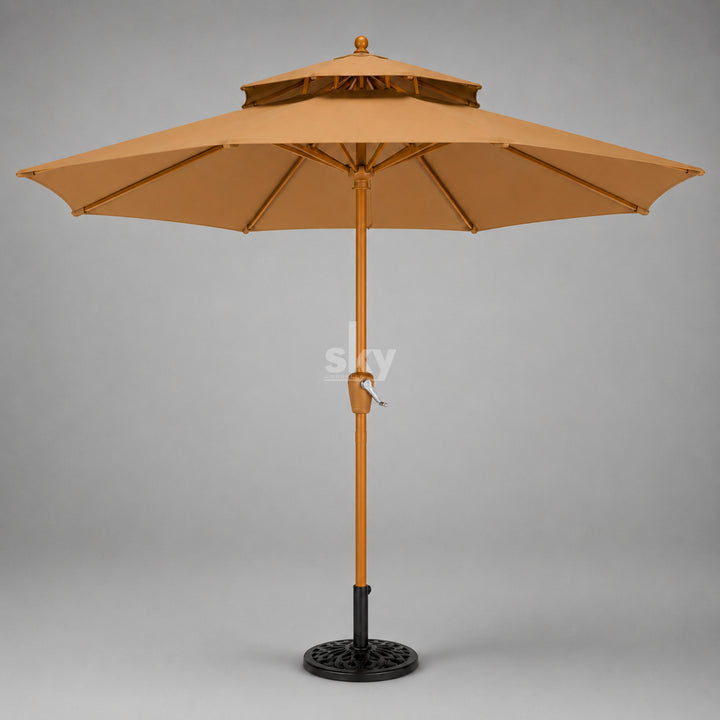
For a resort pool deck, restaurant terrace, or lawn seating area, the 10 ft Thatch Side Pole Umbrella (₹30,000) is the single clearest product-market fit in Sky Umbrella's catalogue for this specific buyer. Its own listing describes a "premium thatch-style canopy" built to "create a luxurious tropical atmosphere" and explicitly names poolside lounges, beach resorts, and farmhouses as its intended setting — and a thatch-look canopy reads as considerably more at-home on a Kerala backwater property, where actual thatched roofing (locally built from coconut palm fronds) is part of the architectural vocabulary, than it would in most of the country. The canopy is 10 ft wide with 360° rotation on a side-pole (cantilever) mount, so the pole sits at the edge of the seating area rather than in the middle of it — useful on a narrow jetty-adjacent deck. The listing is honest that it's a side-pole/offset design rather than a centre-pole one, and that the base is a separate heavy-duty support rather than built into the pole itself. At the time of writing only 2 units are in stock — worth confirming availability before committing to a specific installation date if you're outfitting multiple deck positions.

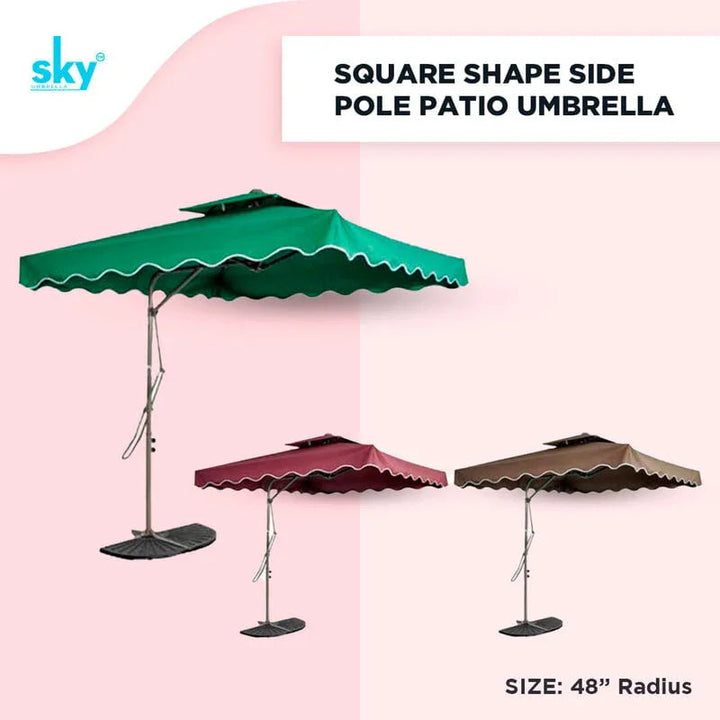
Where the thatch umbrella's price point doesn't fit every seating cluster on a property — and most resorts have more than one outdoor zone to cover — the Round Shape Side Pole Patio Umbrella and Square Shape Side Pole Patio Umbrella (₹7,500 each, 40 and 15 units in stock respectively) give you the same side-pole mounting logic at roughly a quarter of the price, in a plain canopy rather than the thatch finish. For a more distinctive centrepiece — a lawn seating area, a signature photo spot, or a lobby-adjacent courtyard — the newly introduced Luxury Centre Pole Garden Umbrella (₹21,000) brings a scalloped-edge canopy and a wood-finish centre pole, explicitly listed for "resort, café, restaurant, poolside" use; its own spec sheet is upfront that the base/stand is sold separately. A more budget-conscious alternative with a genuinely useful climate feature is the Centre Pole Double Layer Garden Umbrella (₹6,000), whose double-layer ventilated canopy is designed to improve airflow underneath — a small but real comfort advantage in Kerala's humidity, where a single-layer canopy can trap warm, still air under it on a windless, muggy afternoon. It ships with its base included, which simplifies the purchase for a property ordering several at once.
Shade for Ayurveda Retreats & Wellness Courtyards
An Ayurveda retreat's outdoor treatment decks and yoga courtyards need shade that doesn't visually compete with the setting. Both the Luxury Centre Pole and the Centre Pole Double Layer umbrellas work here precisely because their wood-finish poles and restrained, non-branded canopies read as natural rather than commercial — a meaningful difference from the loud printed canopies that suit a restaurant or a trade-show booth but would feel out of place next to an oil-massage table. The double-layer canopy's ventilation benefit is arguably even more relevant here than at a pool deck: guests moving between an open-air treatment space and a rest area in Kerala's humidity benefit from any airflow improvement underneath the shade structure, however modest.
One honest caveat: neither product is marketed as acoustically or visually private, and a true wellness-retreat buyer who needs enclosed privacy (not just shade) should look at Sky Umbrella's Mix & Match Monsoon Kits page or speak directly with the team via Contact Us about pairing an umbrella with separate screening — that's outside what an umbrella alone can solve, and we'd rather say so than oversell the fit.
Umbrellas & Rain Gear for Houseboat (Kettuvallam) Operators
A traditional Kerala houseboat's deck is narrow, moves with the water, and usually has exactly one walking path from the cabin to the open sitting area at the front. A centre-pole umbrella planted in the middle of that path is a tripping hazard waiting to happen — which is precisely why the side-pole/cantilever design family matters more here than anywhere else in this guide. A compact side-pole umbrella positioned at the very edge of the open deck, pole mounted outboard rather than through the deck's centre, keeps the walkway clear while still shading the seating cushions where guests actually sit for photos and sundowners.
For smaller houseboats where even a compact side-pole installation isn't practical, or for the open-air transfer point between jetty and boat where guests often wait a few minutes in the open, handheld umbrellas issued to crew make more sense than any fixed structure — covered in the next section.
Houseboat and jetty crew who work the open deck through both monsoons are also the clearest fit in this guide for dedicated rainwear rather than an umbrella at all: a crew member mooring lines, handling luggage, or managing the gangplank needs both hands free, which rules out an umbrella entirely. The WeatherWise Leo RainSuit (₹899) is built with seam-sealed construction and a water-resistant outer layer specifically to prevent water seeping in at the stitching during heavy, sustained rain — exactly the continuous-exposure condition a backwater crew faces across a six-month window rather than the odd shower.

Handheld & Guest-Facing Umbrellas: Transparent, Hands-Free & Branded Options
One guest-facing detail is easy to overlook: a guest who's paid for a backwater cruise or a scenic resort stay specifically wants to see the scenery — paddy fields, coconut groves, egrets on the water — even while it's raining. Handing them an opaque golf umbrella to walk from jetty to boat solves the "staying dry" problem while creating a new one: it blocks exactly the view they came for. The Transparent Clear Umbrella (₹490) is a small, low-cost fix for this specific moment — a crystal-clear PVC canopy that keeps rain off without obstructing sightlines, worth stocking at jetty transfer points and guest-arrival areas specifically for this reason, not as a general-purpose umbrella for the whole property.

For staff who need both hands free while escorting guests with luggage along a jetty or walking a property's grounds, the Rainbow Hand Free Cap Umbrella (₹250) is worth a mention — though its own listing is upfront that it's built for sun and light-rain protection rather than sustained heavy rain, so it suits a porter or groundskeeper's quick trips rather than someone stationed outdoors continuously. For resorts running a branded guest-gifting or loaner-umbrella program, Sky Umbrella's Promotional Umbrella collection and corporate branding page cover bulk, logo-printed options in more depth than this article has room for.
Buying Guide: What to Specify Before You Order
Before placing an order for a backwater property, work through these points — several of them are specific to Kerala's climate rather than generic umbrella advice:
1. Decide fixed vs. fold-away per location, not per property
A pool deck that's in near-constant use can justify a fixed, left-up installation. A seasonal event lawn or a spot that needs to be cleared for maintenance access is better served by a fold-away unit you store properly between uses (see point 3). Don't apply one answer across the whole property.
2. Match pole style to the walking pattern of the space
Side-pole (cantilever) designs keep the pole out of the usable floor area — the right call for houseboat decks, narrow jetties, and tight pool surrounds. Centre-pole designs are sturdier and usually cheaper for a given canopy size, and make sense anywhere the floor space around the pole isn't a walking path, such as a lawn seating cluster or a wide terrace.
3. Build in an actual drying routine
Every canopy fabric in this guide's product range carries a care instruction to let it dry fully before folding or storing — standard advice that's easy to ignore in a six-month-rain climate where "fully dry" can feel like it never arrives. Properties that skip this step are the ones that see mildew staining and odour on canopies within a single season. Build a covered, ventilated spot into the property's housekeeping routine specifically for umbrella drying, not just general equipment storage.
4. Weigh bases properly, every time
None of the centre-pole products in this guide ship with a base heavy enough to be optional — the Heavy 8Kg Stand Base (₹1,200) is the honest, verified option in Sky Umbrella's current catalogue, though it's worth noting only 4 units are in stock at the time of writing, so order ahead if you're equipping more than a couple of positions. Backwater properties get genuine wind gusts off open water, especially during the northeast monsoon's squally spells, and an under-weighted umbrella is a safety issue around a pool, not just a cosmetic one.

5. Budget canopy replacement into the lifecycle, not just the initial purchase
No umbrella canopy sold today is rated to last indefinitely in near-continuous humidity. Plan for canopy refresh as a recurring line item rather than treating the original purchase as a one-time cost — this is true everywhere but matters more on a six-month-rain cycle than it does in most of the country.
Comparison Table: Which Umbrella Fits Which Spot
| Product | Price | Pole Type | Best For | Stock Note |
|---|---|---|---|---|
| 10 ft Thatch Side Pole Umbrella | ₹30,000 | Side-pole | Signature pool deck / photo spot | Only 2 units — confirm availability |
| Luxury Centre Pole Garden Umbrella | ₹21,000 | Centre-pole | Lawn / lobby courtyard centrepiece | Base sold separately |
| Round / Square Side Pole Patio Umbrella | ₹7,500 | Side-pole | General deck & poolside seating | 40 / 15 units |
| Centre Pole Double Layer Garden Umbrella | ₹6,000 | Centre-pole | Ayurveda courtyards, ventilated shade | Base included |
| Transparent Clear Umbrella | ₹490 | Handheld | Jetty & guest transfers (sightline-preserving) | Well stocked |
| WeatherWise Leo RainSuit | ₹899 | N/A (rainsuit) | Houseboat & jetty crew, continuous exposure | Well stocked |
| Heavy 8Kg Stand Base | ₹1,200 | N/A (base) | Any centre-pole umbrella needing ballast | Only 4 units — order ahead |
Pros & Cons by Umbrella Type
Side-pole (cantilever) umbrellas — Pros: keep the pole clear of the usable deck area, 360° rotation on most models follows the sun without moving the base. Cons: generally pricier than an equivalent centre-pole canopy, and the offset design needs a heavier, more carefully positioned base to stay stable.
Centre-pole umbrellas — Pros: simpler construction, usually lower cost per canopy size, easy to source replacement bases. Cons: the pole occupies floor space directly under the canopy, which is a real constraint on a houseboat deck or in a tight pool surround.
Thatch-style canopies — Pros: the strongest aesthetic match to Kerala's own vernacular roofing style, genuinely distinctive for guest photography. Cons: premium pricing, and the lowest stock levels of any product in this guide at the time of writing.
Handheld transparent umbrellas — Pros: cheap, keeps sightlines open for guests who came for the view. Cons: smaller canopy than a standard handheld umbrella's usual rib spread, so it's a transfer-point solution, not a replacement for proper rainwear on an exposed walk.
Rent vs. Buy for Seasonal Events & Weddings
Destination weddings and one-off events on backwater properties are common enough that rental is worth a mention — but with an honest caveat. Sky Umbrella's Sidepole Outdoor Cafe Umbrella on Rent (₹1,200/unit) and Centerpole Garden Umbrella on Rent (₹800/unit) are both real, in-stock rental products — but both listings are written explicitly around Mumbai, Navi Mumbai, and Thane delivery logistics. We're not going to assume that extends to Kerala. If you're planning a backwater event and want to rent rather than buy, confirm delivery timeline and cost to your specific location directly with the Sky Umbrella team via Contact Us before you commit a wedding date to it — this is exactly the kind of detail that should be confirmed in writing, not assumed from a product listing written for a different region.

Expert Tips from the Field
A few practical points that don't fit neatly into the buying guide above but matter in practice: stagger umbrella replacement across a property instead of ordering everything from one batch at once, so a single fabric or frame issue doesn't take out your entire outdoor seating capacity at the same time. Walk the property at both monsoon's peak and in the dry season before finalising umbrella placement — a spot that looks perfect in February sun may sit in standing water or a wind tunnel in July. And brief housekeeping staff specifically on the drying routine during onboarding, not just as a one-time instruction; canopy damage from skipped drying is almost always a staffing-continuity problem, not a product-quality one.
Case Study: Rethinking Shade for a Mid-Size Backwater Resort
Consider a composite, illustrative example built from the buying patterns described throughout this guide rather than a single named client: a 24-room backwater resort near Kumarakom with a pool deck, a lawn event space, and an open-air restaurant terrace. Under the single-monsoon assumption most of its original umbrellas were bought under, the property had centre-pole umbrellas crowding its narrow pool surround, with guests regularly stepping around poles to reach loungers. Reworking the layout around the side-pole logic in this guide — moving pole-heavy installations to the open lawn where floor space isn't constrained, and fitting the tighter pool surround with side-pole units instead — freed up walking space without reducing the number of shaded seats. Separately, switching the restaurant terrace's single-layer canopies to a double-layer, ventilated design addressed a recurring guest comment about the terrace "feeling stuffy" on still, humid afternoons — a comfort issue that had nothing to do with rain protection at all. Neither change required demolishing or relocating existing structures; both were decisions made at the next umbrella-replacement cycle, which is the realistic point at which most properties can act on advice like this.
Who Else This Applies To
Beyond the three core buyers in this guide, the same side-pole-for-narrow-spaces and humidity-ventilation logic applies to: Ayurveda day-spas in urban Kerala (Kochi, Thiruvananthapuram) that don't have a full retreat campus but do have an outdoor treatment courtyard; heritage homestays converted from tharavads (traditional Kerala houses) with internal courtyards (nadumuttam) that need shade without disrupting the architecture; houseboat operators running shorter day-cruise itineraries rather than overnight stays, where guest-facing handheld umbrellas matter more than fixed deck shade; and canal-side restaurants and toddy shops along the backwater tourist circuit that need affordable, replaceable shade rather than a premium centrepiece installation.
Frequently Asked Questions
Do I need different umbrellas for the southwest and northeast monsoons?
Not different products, but a different maintenance mindset. Because the two monsoons together cover roughly June through early December, treat outdoor shade as a near-permanent installation requiring an ongoing drying and inspection routine, rather than something you put up and take down around a single rainy season.
Is a thatch-style canopy actually more durable in Kerala's climate, or just more fitting aesthetically?
Based on the product's own specifications, it's rated as UV-resistant polyester woven to imitate thatch appearance, not actual organic thatch — so its durability profile is in line with other UV-resistant polyester canopies in this guide, not inherently better or worse. Its advantage here is purely aesthetic fit with Kerala's architectural vocabulary.
Can centre-pole umbrellas work on a houseboat deck at all?
Only on larger, wider-decked houseboats where the pole can be positioned off the main walking line. For a standard-width kettuvallam, a side-pole or handheld solution is the safer specification.
Does the rental umbrella delivery actually extend to Kerala?
We don't know yet, and we're not going to guess. Both rental listings referenced in this guide are written around Mumbai-area logistics. Confirm directly with Sky Umbrella before booking a rental against an event date.
What's the realistic lifespan of a patio umbrella canopy in this climate?
Sky Umbrella doesn't publish a specific lifespan figure for Kerala's conditions, and we won't invent one. What we can say honestly is that every canopy in this guide's product range carries a care instruction to dry fully before storage — properties that follow that instruction consistently should expect a meaningfully longer usable life than those that don't, though we don't have a verified number to attach to "meaningfully longer."
Where can I see pricing and place a bulk order for multiple properties?
Sky Umbrella's corporate umbrella manufacturer page and the Kerala-specific Corporate Umbrella Manufacturers in Kerala and Garden Umbrella Manufacturers in Kerala pages cover bulk ordering and regional delivery; for a specific multi-property order, Contact Us directly is the fastest route to a firm quote.
Conclusion & Next Steps
Kerala's backwater hospitality market deserves buying advice built around its actual climate and actual deck layouts, not a generic national template. Two monsoons instead of one changes the maintenance question from "seasonal" to "near-permanent." Narrow, moving houseboat decks make pole placement a genuine safety and usability issue, not an aesthetic preference. And guests who've booked a backwater experience specifically to see the scenery deserve rain protection that doesn't block the view they came for. Whether you're outfitting a resort pool deck, an Ayurveda courtyard, or a houseboat fleet, match the product to the specific spot rather than buying one umbrella type for the whole property — and if anything in this guide (rental delivery to your location, bulk pricing, or a spec not covered here) needs a direct answer, reach out to the Sky Umbrella team before you commit to an order.
Explore Sky Umbrella's full Garden & Patio Umbrella collection and Raincoat collection for houseboat and resort crew, or visit the Sky Umbrella homepage to browse the full catalogue. For bulk, branded, or multi-property orders, learn more on the Corporate Umbrella Manufacturer page or get in touch via Contact Us.