Umbrellas for Andaman & Lakshadweep Island Resorts (2026): The Complete Remote-Logistics Buying Guide

If you run a resort on Havelock, a dive shop in Agatti, or a homestay on Neil Island, you already know that "just order umbrellas for the season" doesn't work the way it does on the mainland. A courier that reaches Goa or Kerala in three days can take three weeks to reach Port Blair, and it almost never reaches Lakshadweep at all without a special permit and a ship's cargo manifest. Add constant salt spray, humidity that barely drops below 80% for eight months of the year, and a government that (rightly) restricts permanent concrete construction along the coastline, and you have a shade-procurement problem that is genuinely different from anywhere else in this buying-guide series — not just a warmer, wetter version of Goa or Kerala.
This guide is built specifically for that problem: what to buy, how early to order it, which specs actually matter when salt air and monsoon humidity attack a frame at the same time, and why the construction rules that apply in Union Territories like the Andaman & Nicobar Islands and Lakshadweep quietly make portable umbrellas the more sensible choice over a fixed gazebo in the first place.

Table of Contents
- The Island Logistics Problem Nobody Budgets For
- Salt Air Meets Year-Round Humidity: The Double Corrosion Threat
- CRZ Rules and the Case for Portable, Non-Permanent Shade
- Cyclone Season: Storage and Strike-Down Readiness
- Three Buyers, Three Different Briefs
- Expert Tips for Ordering Umbrellas for Island Properties
- The Complete Island Buying Guide
- Comparison Table: Which Product Fits Which Island Need
- Buy vs. Rent: Pros and Cons for Island Hospitality
- Case Study: An Island Resort's Monsoon Shade Overhaul
- Industry Applications Beyond Resorts
- Frequently Asked Questions
- Conclusion
The Island Logistics Problem Nobody Budgets For
Every regional guide in this series has talked about climate. This one starts with freight, because for an Andaman or Lakshadweep buyer, logistics is the first filter everything else has to pass through.
Goods reach Port Blair either by air cargo (expensive, and capacity-limited on passenger flights) or by ship from Chennai, Kolkata or Visakhapatnam, a sailing that commonly takes three to five days on top of however long the goods took to reach the mainland port in the first place. Lakshadweep is more restrictive again: it is reached only from Kochi, by ship or a limited number of flights, and outsiders (including some categories of commercial goods) need an entry permit routed through the Lakshadweep Administration before anything is allowed to land. Neither of these is a same-week fix if a monsoon squall rips a canopy two weeks before a big booking arrives.
The practical takeaway: order your season's shade and rain gear 10 to 12 weeks ahead of when you need it, not the 2-to-3-week runway that works for a Mumbai or Bengaluru property. Consolidate everything — umbrellas, bases, rainsuits — into one shipment rather than three separate reorders, since each additional shipment means another multi-day sailing and another customs/permit cycle for Lakshadweep specifically. And where the choice exists, favour lighter accessories: a resin base that weighs 8kg costs meaningfully more to freight to an island than a foldable steel stand that weighs under 2kg, even before you account for the fact that heavier cargo is more likely to get bumped off a space-constrained flight manifest.
This is also exactly why we are honest about what we cannot promise: Sky Umbrella does not operate island-specific logistics or a guaranteed delivery window to Port Blair or Kochi-to-Lakshadweep sailings. Every order to these Union Territories should be placed with enough buffer that a delayed sailing doesn't become a missed season, and property managers should confirm current freight-forwarder options with us directly before finalising an order date.
Salt Air Meets Year-Round Humidity: The Double Corrosion Threat
Goa and Mumbai's coastal guides already cover salt-air corrosion. Island properties face a harsher version of the same problem because there is no inland buffer at all — a beachfront cottage on Havelock or a lagoon-facing cottage in Kadmat is often within a few dozen metres of salt spray on every side, not just one coastal-facing elevation. Layer onto that Andaman's near-continuous humidity (the islands get both the southwest monsoon from roughly May to September and a secondary northeast monsoon pulse from October into December, so there is barely a fully dry season), and untreated steel frames, uncoated hinges and cheap canopy stitching fail considerably faster here than they would on the mainland.
Three specs are worth insisting on for any umbrella headed to an island property:
- Rust-proof fiberglass ribs over plain steel wherever the budget allows — fiberglass doesn't pit or corrode the way steel does under constant salt exposure, and it also flexes under gusts rather than bending permanently.
- A genuinely water-resistant canopy weave (Oxford fabric in the 220–230 GSM range is the honest working standard here, not a loosely-used "waterproof" label) — a lower-GSM fabric soaks through and stays damp in this humidity, which accelerates mildew.
- Simple mechanical hardware over anything battery-dependent as the primary shade mechanism — in a humid salt environment, every additional electronic or battery component is one more thing that corrodes or fails; keep powered features (like a cooling fan) as a nice-to-have add-on, never the umbrella's core function.

CRZ Rules and the Case for Portable, Non-Permanent Shade
Here is the angle that doesn't come up in any mainland regional guide in this series: both the Andaman & Nicobar Islands and Lakshadweep fall under India's Coastal Regulation Zone (CRZ) framework, and because they are ecologically sensitive island territories, construction near the shoreline is scrutinised more tightly here than in most mainland coastal states. Permanent concrete footings, built-up gazebos and fixed pergolas close to the high-tide line routinely require clearances that a simple, removable shade structure does not.
We want to be precise about what we are and are not claiming here: we are not a construction-law or CRZ-compliance authority, and the exact clearance requirements for any specific plot depend on its CRZ classification, which varies by location and changes with policy updates. What we can say, based on how our hospitality customers in ecologically regulated zones generally approach this, is that a freestanding, non-foundational umbrella on a portable or shallow-set base is typically viewed very differently by local planning and forest/coastal authorities than a permanent masonry structure — because it can be removed entirely and leaves no permanent footprint. If you are planning shade for a beachfront or shoreline-adjacent plot in either territory, confirm your specific CRZ classification and any permitted-structure guidance with the local Andaman & Nicobar Administration or Lakshadweep UT Administration planning office before you build anything fixed. For nearly every genuine need we see — poolside lounging, a dive-briefing area, a breakfast deck — a well-anchored side-pole or centre-pole umbrella on a demountable base solves the shade problem without raising that question at all.
Cyclone Season: Storage and Strike-Down Readiness
The Bay of Bengal generates tropical depressions and cyclones most years between roughly April and December, with the Andaman Sea often the first water a developing system crosses. We are not going to cite a specific storm, date or wind-speed record here — our search tools returned no fresh, verifiable data this run, and inventing a statistic would be worse than not having one. What is well established and safe to say plainly: a region with a multi-month cyclone-risk window needs outdoor shade that can be struck down quickly and stored, not just umbrellas that are heavy enough to survive an ordinary squall.
This tips the calculation away from permanently bolted-down installations and toward umbrellas on a stand that two staff members can fold, detach and carry indoors within the lead time a cyclone warning actually gives you — often measured in hours, not days. No umbrella frame on the market, from Sky Umbrella or anyone else, is rated to withstand cyclone-force winds left standing; the honest advice for any island property is to build a simple storm-storage routine (where the furniture goes, who is responsible, how long it takes) around whatever shade you buy, rather than looking for a mythical "cyclone-proof" umbrella that does not exist.
Three Buyers, Three Different Briefs
1. Beach and lagoon-facing resort properties
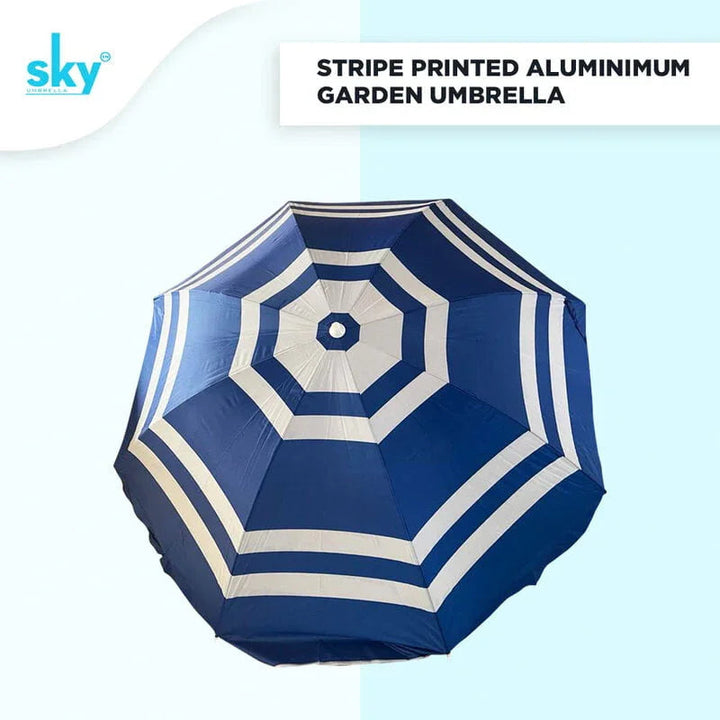
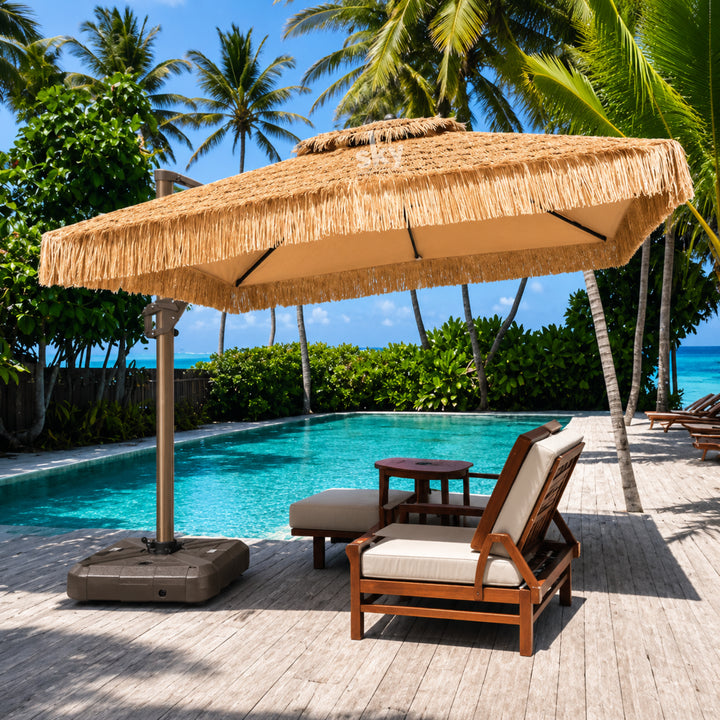
Boutique resorts on Havelock (Swaraj Dweep), Neil Island (Shaheed Dweep), and Lakshadweep's lagoon islands such as Bangaram, Kadmat and Agatti need shade that looks resort-appropriate at the pool deck, breakfast lawn or beachfront cottage cluster, survives salt spray on every side, and can be struck down fast when a cyclone warning comes through. A Round Shape Side Pole Patio Umbrella or its Square Shape Side Pole Patio Umbrella sibling both keep the ground beneath completely clear of a centre post — useful on a narrow jetty-facing deck where every square foot of usable space counts — and both are explicitly spec'd by their own listing for garden, patio and beach use.
2. Dive schools and watersports operators
Andaman and Lakshadweep's diving and snorkelling operators (PADI dive centres on Havelock and around Port Blair, watersports counters at lagoon resorts) run a gear-check desk that is outdoors all day, every day, in direct sun between dives and sudden rain in between. Staff need hands mostly free to handle tanks, fins and paperwork, so a fixed canopy over the counter matters more than a handheld umbrella, and whatever rain gear boat crew wear needs to survive being wet, salty and folded away in a dry-bag routine day after day.
3. Island-hopping travellers and ferry passengers
A genuinely new persona for this series: visitors doing the Port Blair–Havelock–Neil Island ferry circuit, or the inter-island government ferry/seaplane hops within Lakshadweep, spend real time standing on open jetties waiting to board, often in a sudden squall with luggage in hand. A compact, clip-on umbrella that survives a jetty crossing and folds small enough for a daypack is a different product need from anything a fixed resort property buys.

Expert Tips for Ordering Umbrellas for Island Properties
- Order by quarter, not by month. Place one consolidated order ahead of each monsoon window (southwest and northeast) rather than reordering piecemeal — freight cost per unit drops sharply when it's spread across a bigger shipment.
- Buy one spare canopy or umbrella for every four to five in active use. On the mainland a damaged canopy is a same-week replacement; on an island it can mean weeks without shade at that station. A small buffer stock is cheap insurance against the exact logistics problem this guide opens with.
- Weigh your base choice against your freight bill, not just wind resistance. An 8kg resin base is the sturdier choice for a fixed installation on the mainland, but a foldable 4-leg stand that weighs a fraction as much is often the more sensible island pick when every kilogram is shipped by air cargo or deck cargo.
- Brief your housekeeping or FM team on a storm-storage drill — which umbrellas come down first, where they're stored, and who owns the task — the moment a cyclone watch is issued, not the moment the wind picks up.
- Don't over-invest in printed branding for beachfront units. Salt spray and sun fade custom prints faster in this environment than almost anywhere else in India; a plain or single-colour canopy with your property's colour, paired with branded signage elsewhere, ages better than an elaborate print that looks tired within one season.
The Complete Island Buying Guide
Four criteria matter more here than in any mainland regional guide in this series:
1. Shipping weight and lead time
Before comparing canopy size or colour, check what the umbrella and its base together weigh, and build in at least a 10–12 week order window. A lighter, foldable base is very often worth trading a little wind resistance for, given freight realities.
2. Frame and fabric resistance to combined salt-and-humidity exposure
Rust-proof fiberglass ribs, a 220–230 GSM water-resistant canopy weave, and minimal battery-dependent hardware in the primary shade mechanism.
3. Footprint and permanence
Favour a portable or shallow-set base over a poured foundation on any shoreline-adjacent plot, and confirm your CRZ classification with the local planning authority before building anything fixed.
4. Strike-down speed before a cyclone warning
If two staff members can't fold, detach and move the unit indoors in well under an hour, it's the wrong base-and-umbrella combination for a cyclone-risk coastline, however good it looks on an ordinary day.

Comparison Table: Which Product Fits Which Island Need
| Product | Best for | Price | Why it fits the island brief |
|---|---|---|---|
| Round Shape Side Pole Patio Umbrella | Poolside & beachfront resort decks | ₹7,500 | Side-pole keeps the deck clear; own spec names beach/patio/resort use |
| Square Shape Side Pole Patio Umbrella | Rectangular breakfast/lounge seating sets | ₹7,500 | Square canopy matches a dining-table footprint; same fabric and build |
| 4-Leg Stand for Garden Outdoor Umbrella | Any centre-pole umbrella needing a lighter, foldable base | ₹450 | A fraction of the weight of a resin base — cheaper to ship, faster to strike down |
| Built-In Fan Umbrella | Day-trippers and beachgoers wanting active cooling in high humidity | ₹1,999 | Own spec lists beach/camping use directly; battery fan is a bonus, not the only shade mechanism |
| Transparent Clear Umbrella | Jetty boarding and ferry-transfer visibility | ₹490 | Clear canopy keeps sightlines open while boarding a boat or seaplane in rain |
| Compact 3Fold Travel Umbrella | Island-hopping travellers on the ferry circuit | ₹599 | Carabiner clip attaches to a daypack; auto open/close is fast on a moving jetty |
| WeatherWise Leo RainSuit | Boat crew and dive-school staff on continuous outdoor duty | ₹899 | Hands-free, seam-sealed protection for staff who can't carry a handheld umbrella while working |
Two further options are worth a mention without a dedicated feature here: the Promotional Golf Umbrella and Double Layer Golf Umbrella both work well as a doorman/welcome umbrella for arriving guests at a jetty or helipad transfer point, and both are made-to-order (quote-only) rather than held as stock, so build their longer production lead time into your 10–12 week ordering window. The budget-tier Multi Color Garden Outdoor Umbrella (₹699) is a reasonable low-cost fixed-shade option for a homestay or guesthouse lawn where resort-grade specs aren't the priority.
Buy vs. Rent: Pros and Cons for Island Hospitality
On every mainland regional guide in this series, renting event umbrellas for a wedding or festival season has been a genuine option. For Andaman and Lakshadweep, we need to be more direct than we have been before: Sky Umbrella's rental umbrella listings are built around Mumbai-area delivery logistics, and extending that to a multi-day sea or air cargo route to Port Blair, let alone the permit-gated route into Lakshadweep, is very unlikely to be practical or cost-effective for anything short of a very large event. Our honest recommendation for island properties is to buy outright rather than plan around renting, and to treat buying one or two spare units (see the Expert Tips above) as your actual flexibility buffer instead.
| Buying outright | Renting (mainland-style) | |
|---|---|---|
| Upfront cost | Higher, one-time | Lower per use, but recurring |
| Island logistics fit | One consolidated shipment, planned 10–12 weeks ahead | Needs repeat shipments timed to each event — currently impractical for these two territories |
| Storm-season flexibility | You control strike-down and storage timing directly | Dependent on a mainland-based rental partner's own schedule |
| Best fit | Resorts, dive schools, standing hospitality operations | A genuinely one-off mainland event — not recommended for island delivery today |
Case Study: An Island Resort's Monsoon Shade Overhaul
The following is an illustrative scenario built from common patterns we see across island and coastal hospitality buyers, not a named client.
A 14-cottage boutique property on Havelock had been reordering plain garden umbrellas from a mainland supplier roughly once a season, replacing two or three units each time a canopy tore or a steel rib rusted through. Shipping delays meant the replacement stock sometimes arrived four to six weeks after the original order, occasionally missing the start of the next tourist season entirely. Moving to a single consolidated order of side-pole patio umbrellas with rust-proof fiberglass ribs, placed twelve weeks ahead of the October season opening, cut their mid-season reordering to zero that year and meant every unit was in place before the first guests arrived. The property also switched its poolside units from heavy resin bases to foldable 4-leg stands specifically to cut air-freight weight, and built a one-page storm-storage checklist for housekeeping staff to follow the moment a cyclone watch is issued for the Andaman Sea.
Industry Applications Beyond Resorts
- Dive schools and watersports counters — fixed side-pole shade over a gear-check desk, with rainsuits for instructors running sessions through sudden squalls.
- Government rest houses and circuit houses — officials and visiting staff on Andaman and Lakshadweep postings need practical, low-maintenance shade and rain gear for compounds that see the same freight constraints as private resorts.
- Ferry and jetty operators — waiting areas at Port Blair's Phoenix Bay jetty or Havelock's jetty benefit from fixed shade for queuing passengers, alongside compact umbrellas sold or rented to travellers at the counter.
- Homestays and budget guesthouses — a lawn or rooftop seating area doesn't need resort-grade specs, but still benefits from the same lightweight-base, salt-resistant-frame logic on a smaller budget.
- Research stations and forest department outposts — field staff working outdoors through the monsoon need durable personal rain gear more than branded shade.
Frequently Asked Questions
Do any Sky Umbrella products carry a cyclone-rating certification?
No. No umbrella on the market today, from us or any manufacturer, is certified to withstand cyclone-force winds while standing. Every island property should plan a strike-down and storage routine rather than relying on any umbrella's wind rating during an actual cyclone warning.
How far in advance should we order umbrellas for a Havelock or Lakshadweep property?
Plan for 10 to 12 weeks from order to delivery, and consolidate your season's full order (umbrellas, bases, rainsuits) into one shipment rather than several smaller ones.
Can we rent umbrellas for a one-off event on the islands?
Our current rental umbrella stock is logistically built around Mumbai-area delivery, and extending that to Andaman or Lakshadweep is unlikely to be practical today. For island properties we recommend buying outright and keeping a small spare-unit buffer instead.
Are there specific CRZ rules that say umbrellas don't need a permit?
We're not a planning or legal authority, and CRZ classification varies by exact plot and changes with policy updates, so we won't state a blanket rule here. What we can say is that a portable, non-foundational umbrella is generally viewed differently from a permanent masonry structure by coastal planning authorities, because it leaves no permanent footprint. Confirm your plot's specific classification and any permitted-structure guidance with the local Andaman & Nicobar Administration or Lakshadweep UT Administration planning office before building anything fixed.
Why not just use a heavier base for better wind resistance?
A heavier resin base is genuinely more wind-stable on an ordinary day, but it costs more to ship to an island and is slower to move during a storm-storage drill. For most island properties, a lighter foldable base paired with good storm-season discipline is the more practical overall choice — though a fixed, high-footfall installation (like a resort's main pool deck) may still justify the heavier option if freight cost allows for it.
Do fabric canopies hold up in near-constant humidity, or do they mildew?
A good water-resistant Oxford-weave canopy resists mildew far better than a low-GSM fabric, but no canopy is mildew-proof in near-constant humidity. Plan on airing and fully drying canopies between uses whenever the weather allows, and expect to replace canopies somewhat more often here than on the mainland.
Conclusion
Andaman and Lakshadweep aren't a hotter, wetter version of Goa or Kerala — they're a genuinely different procurement problem, built around freight lead time, double-exposure corrosion, coastal construction rules, and a multi-month cyclone-risk calendar that no other region in this series has to plan around all at once. Get the logistics and the base-weight trade-off right, and the actual umbrella choice is often the easiest part of the decision.
If you manage shade or rain-gear procurement for a resort, dive school, ferry operator or guesthouse on either island chain, get in touch with our team to plan your season's order around a realistic shipping timeline, or browse our full Garden & Patio Umbrella collection and WeatherWise Raincoat collection to start building your order. For bulk, branded or corporate orders, see our Corporate Umbrella Manufacturer page, or learn more about Sky Umbrella on our About Us page.
Related reading: Umbrellas for Goa Restaurants & Events · Kerala's Backwater Resorts · Pondicherry's Cafés & Heritage Hotels · Wind-Rated Patio Umbrellas for Coastal Properties · Best Umbrellas for the Beach · Umbrella Stands & Bases Buying Guide · Transparent Umbrellas Buying Guide · Resort Outdoor Shade Strategy