Umbrellas & Rain Gear for Housing Society Security Guards in India (2026): The Complete RWA Welfare-Kit Buying Guide
Every monsoon, the same conversation plays out in managing-committee WhatsApp groups across Indian housing societies: someone posts a photo of the night-shift watchman standing under the gate shed holding a garbage bag over his head, and someone else replies "we really need to sort this out this year." Then the rains ease off in October, the thread goes quiet, and the same photo resurfaces the following June.
This guide is for the person who actually has to close that thread — the RWA secretary, the facility manager, the housekeeping vendor, or the CSR head of a corporate campus — with a real budget line, a real headcount, and a real deadline before the next downpour. It is not about branding or marketing umbrellas. It is about equipping the people who stand at your gate, patrol your compound, and keep your lifts and gardens running, with rain gear that actually survives a full monsoon of daily use.
Table of Contents
- Why Housing Societies and Facility Managers Are Rethinking Guard Rain-Gear in 2026
- Who Actually Approves This Purchase (and Why It's Different From Corporate Gifting)
- Personal Rain-Gear vs Fixed Gate Shade: Two Separate Budget Lines
- What Makes a Good "Duty Umbrella" Different From an Everyday One
- The Buying Guide: How to Plan an RWA Welfare-Kit Order
- Comparison Table: Matching Products to Roles and Budgets
- A Realistic Case Study: Budgeting for a Mid-Size Gated Society
- Pros and Cons: Bulk Welfare Kits vs Letting Staff Buy Their Own
- Where Else This Applies: Beyond the Residential Society Gate
- Expert Tips for a Kit That Actually Gets Used
- Frequently Asked Questions
- Conclusion and Next Steps

Why Housing Societies and Facility Managers Are Rethinking Guard Rain-Gear in 2026
Two things have changed the conversation around guard welfare kits this year. First, most large Indian cities have had at least one season in the last three years with a documented spike in heavy-rainfall days, and RWA committees that were caught with waterlogged security cabins and sick-leave spikes among gate staff are no longer treating rain gear as a nice-to-have. Second, facility management companies — the ones that actually employ most housing-society security and housekeeping staff on contract — have started including "monsoon welfare kit" as a standard line item in their annual service proposals, which means societies that don't ask for one are now visibly behind the ones that do.
There's also a simpler, less dramatic reason: attrition. Security and housekeeping staff in Indian metros change employers frequently, and a society that visibly looks after its on-ground staff — proper rain gear, a dry place to sit, basic welfare gestures around Diwali — has an easier time retaining guards through a full monsoon instead of managing a revolving door of new faces who don't know the residents or the building's routines.
None of this needs to be complicated or expensive. It needs to be planned before the first heavy spell, not after the third WhatsApp complaint.
Who Actually Approves This Purchase (and Why It's Different From Corporate Gifting)
This is worth spelling out because it changes what you should actually buy. A corporate gifting order for client umbrellas is approved by a marketing or admin team with a brand budget, and the product needs a logo, a premium unboxing feel, and a story. A guard welfare-kit order is usually approved by one of three very different people, and none of them care about branding:
- The RWA treasurer or secretary, working from a "staff welfare" line inside the society's annual maintenance budget, usually approved at a managing-committee meeting and often needing sign-off at the AGM if it's a recurring commitment.
- The facility management (FM) company's site supervisor or regional manager, who budgets welfare kits per contracted headcount across multiple client sites and needs a consistent, reorderable SKU rather than a one-off custom print.
- A corporate campus's admin or CSR team, buying for outsourced security and housekeeping vendors on their own premises — often as part of a documented vendor-welfare or CSR policy, distinct from client-facing gifting.
In all three cases, the deciding factors are durability, per-unit cost at bulk quantities, and how easy the item is to reorder next year — not how impressive it looks in a gift box. That's a genuinely different buying brief from almost every other bulk-umbrella article on this site, which is exactly why it deserves its own guide.
Personal Rain-Gear vs Fixed Gate Shade: Two Separate Budget Lines
One mistake we see constantly in early-stage RWA planning: societies think about "the umbrella problem" as one purchase, when it's actually two separate categories with different budgets, different approval paths, and different products.
Personal rain-gear is what a guard, watchman, gardener, or liftman carries or wears — a duty umbrella or a rainsuit, bought per head, replaced individually as they wear out, and ideally handed over as a named item so it isn't left behind when staff rotate.
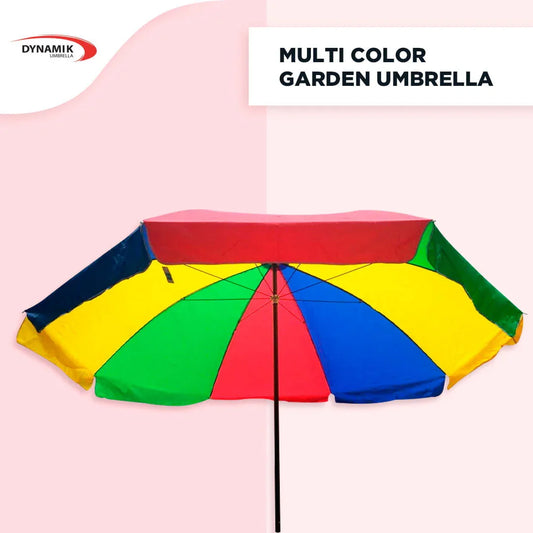
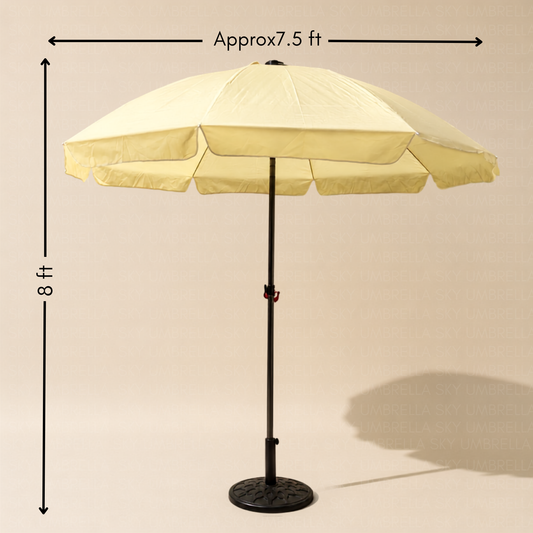
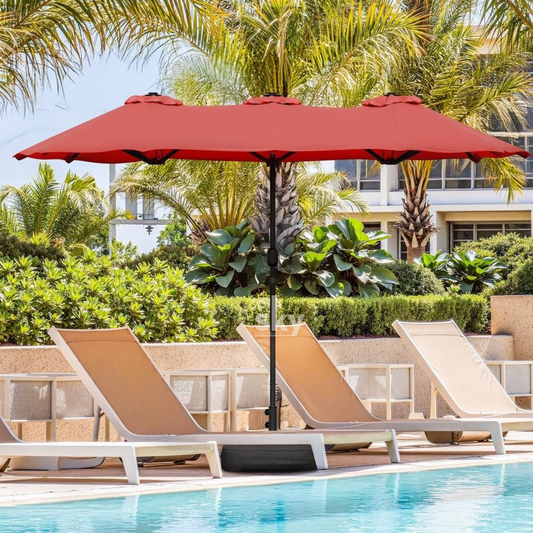
Fixed gate shade is a completely different purchase: a large, ground-mounted umbrella with a stable base that covers the security cabin, the gate desk, or an open-air watchman post so the person on duty has a genuinely dry, shaded spot to stand even when they're not holding anything. This is a one-time capital purchase from the society's amenities or infrastructure budget, not a recurring welfare-kit line.
Trying to solve the fixed-shade problem with a personal umbrella (propped against a wall, tied to a railing) is exactly the "garbage bag over the head" problem this guide opened with — it looks improvised because it is. A dedicated center-pole umbrella on a heavy weighted base, sized correctly for the gate structure, solves it properly and only needs to be bought once.

What Makes a Good "Duty Umbrella" Different From an Everyday One
Hands-Free vs Handheld — Which Roles Need What
A guard who stands at a fixed post for an 8-to-12-hour shift has completely different needs from a guard who patrols the compound on foot, checks parking areas, or opens gates for vehicles every few minutes.
For a patrolling or gate-opening role, both hands need to stay free — for a walkie-talkie, a register, a barrier lever, or simply to hold an umbrella isn't practical while checking IDs. A wearable, hands-free option like the Rainbow Hand-Free Cap Umbrella (₹250) solves this directly — it sits like a cap with an adjustable elastic headband, leaves both hands completely free, and folds down when not in use. It's designed as a novelty/outdoor product in its own listing, but the mechanic — hands-free coverage during light-to-moderate rain — is exactly the fit for gate and lobby duty where hands are constantly busy.

For a stationary post — the main gate desk, a lobby, a society office — a proper windproof handheld umbrella that can survive being left open at a fixed spot for hours is the better fit. The Classic Premium Windproof Umbrella (₹1,599, 27-inch canopy, 16 reinforced ribs) is built for exactly this kind of sustained, heavy-weather standing use rather than a quick dash from car to lobby.
Durability Over Logo — What RWAs Should Prioritize
Unlike a client-gifting umbrella that's judged on first impression, a duty umbrella is judged on how it looks in month three of daily use. Reinforced ribs, a rust-resistant metal frame, and a genuinely windproof build matter far more here than a glossy print. If your society or FM company does want a name or logo on the canopy — many do, purely for accountability so staff don't "borrow" the umbrella home — a simple single-panel print on a durable frame is enough; save the premium multi-panel branding budget for actual client-facing gifting.
The Buying Guide: How to Plan an RWA Welfare-Kit Order
A few concrete steps make this a much smoother process than the usual last-minute scramble:
- Count heads by role, not just by headcount. A 200-flat society might have 6 security guards across three shifts, 2 gatekeepers, 3 housekeeping staff, 2 gardeners, and 2 liftmen — each role has a different rain-gear need, so don't order one SKU for everyone.
- Separate the fixed-shade budget from the personal-kit budget. Decide first whether the security cabin or gate post actually needs a ground-mounted umbrella and base — this is usually a one-time spend, sanctioned separately from the annual welfare kit.
- Set a per-person budget tier — most societies land somewhere between an economy tier (~₹90–120/unit) for larger headcounts and a premium tier (~₹1,500+) for a smaller number of senior or client-facing staff (lobby/reception guards, for instance).
- Decide on rainsuits for anyone on continuous outdoor rounds — an umbrella alone doesn't protect someone walking compound rounds in sideways rain; a proper rainsuit is the better call for that specific role.
- Order slightly above headcount — budget for 10–15% spares to cover breakages and new joiners mid-season, so you're not placing a second small order at a worse per-unit price later.
- Time the order for pre-monsoon, not during it — placing the order in April–May avoids peak-season lead times and lets you distribute kits before the first heavy spell, not after residents have already started complaining.


Comparison Table: Matching Products to Roles and Budgets
| Role / Need | Recommended Product | Price | Why It Fits |
|---|---|---|---|
| Patrol / gate-opening (hands must stay free) | Rainbow Hand-Free Cap Umbrella | ₹250 | Wearable, both hands free, quick to fold for short bursts of rain |
| Fixed gate desk / lobby duty | Classic Premium Windproof Umbrella | ₹1,599 | 27" canopy, 16 ribs, built to stay open for hours in strong wind |
| Rotational / multi-shift staff who carry a bag | Compact 3-Fold Travel Umbrella | ₹599 | Carabiner clip attaches to a duty bag; auto open/close for one-handed use |
| Continuous outdoor rounds (gardeners, parking staff) | WeatherWise Leo RainSuit | ₹899 | Full-body seam-sealed coverage; an umbrella alone isn't enough here |
| Large headcount, premium bulk tier | 3 Fold Auto Open & Close Umbrella | ₹250–350/pc* | One-button operation, reinforced fibre ribs, good for FM-company multi-site orders |
| Large headcount, economy bulk tier | Promotional 2-Fold Umbrella | ₹90–120/pc* | Available in 21"/24"/27", lowest per-unit cost for big headcounts |
| Fixed gate/cabin shade (one-time capital item) | Center Pole Garden Parasol Umbrella + Heavy 8Kg Stand Base | ₹3,499 + ₹1,200 | A genuine dry, shaded post — not a propped-up personal umbrella |
*Bulk pricing shown is per Sky Umbrella's own published price range and varies with order quantity — contact Sky Umbrella for an exact quote at your headcount.

A Realistic Case Study: Budgeting for a Mid-Size Gated Society
Consider a fairly typical mid-size gated community: roughly 250 flats, a managing committee that runs on an annually reviewed maintenance budget, and a facility contract covering 5 security guards (rotating three shifts), 2 gatekeepers, 4 housekeeping staff, and 2 gardeners — 13 people in outdoor or semi-outdoor roles.
A sensible split looks like this: the two fixed gate-desk positions get a windproof handheld umbrella each (2 × Classic Premium Windproof, ≈₹3,200); the patrolling guards and gatekeepers who need hands free get the wearable cap umbrella (5 × Rainbow Hand-Free Cap, ≈₹1,250); the gardeners and housekeeping staff doing continuous outdoor rounds get rainsuits rather than umbrellas (6 × WeatherWise Leo, ≈₹5,400); and the security cabin itself gets a one-time center-pole umbrella and weighted base (≈₹4,700) so the desk position has genuine shelter regardless of who's on duty.
That's a personal welfare-kit spend in the region of ₹9,850 recurring annually (with normal wear-and-tear replacement) plus a one-time ₹4,700 capital item for the gate shade — a modest enough number that most societies can sanction it inside a single AGM budget line without needing a special resolution, especially once it's framed as staff welfare rather than a discretionary spend.
This is an illustrative planning example based on typical Indian housing-society staffing patterns and Sky Umbrella's published pricing — not a specific client engagement — but the ratios and reasoning scale up or down cleanly for larger or smaller societies and FM contracts.
Pros and Cons: Bulk Welfare Kits vs Letting Staff Buy Their Own
| Pros | Cons | |
|---|---|---|
| Society-provided bulk welfare kit | Consistent quality across all staff; easier to budget and reorder; visible goodwill that helps retention; can be tracked as a documented welfare/CSR line for audit purposes | Upfront bulk order and lead time required; someone needs to own distribution and replacement tracking |
| Staff buy their own | No upfront society spend; staff choose what suits them | Wildly inconsistent quality (the "garbage bag" scenario); guards on lower wages often go without proper gear entirely; nothing to show for CSR/welfare reporting; higher effective cost per unit if bought individually at retail |
Where Else This Applies: Beyond the Residential Society Gate
The same buying logic applies well beyond a single apartment complex:
- Corporate campuses and IT parks outsourcing security and housekeeping to a vendor, where welfare-kit provisioning is increasingly written into the vendor contract or documented under CSR/vendor-welfare policy.
- Facility management companies servicing dozens of residential and commercial sites, who standardize on one or two reorderable SKUs across all their contracts rather than negotiating a new purchase per building.
- Builders and developers handing over new gated projects, who often provision an initial welfare kit for the appointed security/FM vendor as part of the handover package.
- Standalone commercial buildings and small business parks with their own on-payroll or contracted security staff, following the same fixed-post-vs-patrol logic described above.
If your interest is the civic/CSR-sponsorship angle rather than in-house facility staff, our guide to umbrellas for traffic police in India covers that adjacent but distinct mechanism. And if you're specifically outfitting hotel doorstaff rather than a residential or corporate security team, see our doorman and valet umbrella service guide for the guest-experience version of this problem.

Expert Tips for a Kit That Actually Gets Used
- Issue kits as named, tracked items, not communal stock — an umbrella that "belongs to the gate" tends to disappear during a shift change; one issued to a named employee gets looked after.
- Match the tier to the role, not a flat per-head budget — spending ₹1,599 on a windproof umbrella for a patrolling guard who needs both hands free wastes the "windproof, stand-still" features that money is paying for.
- Store a small reserve stock on-site — 2–3 spare units at the society office cover a sudden breakage without waiting on a reorder mid-monsoon.
- Combine the kit with a Diwali welfare gesture where budgets allow — many societies already do a Diwali bonus or hamper for gate and housekeeping staff, and pairing it with a rain-gear refresh (see our year-end gifting guide for packaging ideas) lands well with staff even outside monsoon season.
- Revisit the fixed-shade setup annually, not just the personal kits — canopies fade and stands rust faster than most committees expect; our dedicated umbrella stands and bases guide covers what to check.
- Put the reorder decision on someone's calendar, not their memory — the single biggest cause of "we forgot again this year" is that the person who ordered kits last monsoon has since changed roles, rotated off the committee, or simply moved on. A one-line note in the AGM minutes ("review guard welfare-kit stock every March") outlives any one individual's memory.
Frequently Asked Questions
Is a welfare-kit umbrella order tax-deductible or claimable as a business expense for an RWA or FM company?
Staff welfare spending of this kind is typically treated as a legitimate operating/welfare expense under a society's maintenance budget or an FM company's contract costs, but the specific tax treatment depends on your entity type and accounting practice — check with your society's or company's accountant or auditor before assuming a particular tax position.
How many umbrellas should a housing society budget for per guard?
One primary unit per person is standard, plus a 10–15% spare-stock buffer across the total headcount to cover breakages and new joiners without a rushed reorder mid-season.
Should the gate umbrella have the society's name printed on it?
Many societies do add a simple single-panel print — mainly so staff don't take the umbrella home when they leave — but it's optional. Unlike client gifting, there's no marketing reason it has to carry branding.
What's the difference between a "duty umbrella" and a regular umbrella?
Mainly reinforced build quality for sustained daily outdoor use — stronger ribs, a genuinely windproof frame, and either a hands-free or bag-clip design suited to the specific role, rather than a light umbrella meant for occasional personal use.
Is it better to buy rainsuits or umbrellas for outdoor staff?
It depends on the role. Staff who stand at one spot are usually well served by a good umbrella. Staff who walk continuous rounds — gardeners, parking attendants, patrol staff on foot — are better protected by a full rainsuit, since an umbrella alone doesn't cover sideways rain during movement.
Can Sky Umbrella supply a mixed order across different products in one welfare kit?
Yes — Sky Umbrella's Mix & Match Monsoon Kits program is built for exactly this kind of role-based mixed order rather than requiring one single SKU across an entire headcount.
Do we need a separate purchase for the security cabin shade, or does a personal umbrella cover it?
A separate purchase. A ground-mounted, weighted-base umbrella is a one-time capital item that provides fixed shelter regardless of who's on duty; a personal handheld umbrella is not a substitute and won't hold up to being propped open for hours at a time.
How far in advance of the monsoon should an RWA place this order?
April or early May is the safer window for most Indian cities, well ahead of the first heavy spells. Ordering in June or later usually means longer lead times as demand across the industry peaks at the same time, and it risks staff going without proper gear through the earliest, often heaviest, weeks of the season.
Conclusion and Next Steps
The societies and facility managers who get this right treat it as two small, planned purchases — a personal rain-gear kit matched to each role, and a one-time fixed-shade setup for the gate — made before the monsoon starts, not scrambled together after the first complaint. None of it needs to be expensive or elaborate. It just needs to actually fit the job the person is doing.
If you're planning a welfare-kit order for your society, FM contract, or corporate campus, Sky Umbrella's Mix & Match Monsoon Kits page lets you combine role-based products into one order, and the team can quote bulk pricing directly. Browse the full promotional umbrella collection and garden and gate-shade umbrellas, or get in touch via Contact Us to plan your headcount and budget before the next heavy spell arrives. You can also learn more about Sky Umbrella's manufacturing standards on our About Us page or the dedicated corporate umbrella manufacturer page.