Umbrella Weight Explained (2026): What Really Makes an Umbrella Light or Heavy
If you have ever lifted two umbrellas side by side and wondered why one feels like a toy and the other feels like a tent pole, you have already discovered the gap this article closes. Sky Umbrella's product catalogue spans a 6-rib pocket umbrella that disappears into a handbag and a 16-rib windproof umbrella built for Mumbai's sideways monsoon rain — and almost nobody selling either one tells you what they actually weigh.
That is not a Sky Umbrella problem specifically. Across the Indian umbrella trade, exact gram weights are rarely published on a product listing, even though weight quietly decides three very different buying decisions: whether a commuter will actually carry an umbrella every day, whether a corporate gifting order of 2,000 pieces blows past its freight budget, and whether a "lightweight" umbrella sacrifices the wind resistance a buyer actually needs. This guide pulls that decision apart honestly — including naming where Sky Umbrella's own listings don't publish an exact figure — so you can buy (or brief a vendor) with your eyes open.

Table of Contents
- Why Umbrella Weight Actually Matters
- What Actually Determines an Umbrella's Weight
- Umbrella Weight Classes, Explained Honestly
- Weight vs. Durability: The Real Tradeoff
- Expert Tips for Judging Weight Before You Buy
- Case Study: A Bulk Buyer's Freight-Weight Surprise
- Buying Guide: Choosing the Right Weight for Your Use Case
- Comparison Table: Sky Umbrella Models by Weight Class
- Pros & Cons: Lightweight vs. Heavy-Duty Umbrellas
- Industry Applications
- Bulk-Shipping Weight Math for Corporate Buyers
- Frequently Asked Questions
- Conclusion
- Get the Right-Weight Umbrella for Your Need
Why Umbrella Weight Actually Matters
Weight rarely makes it onto anyone's checklist until an umbrella has already failed at its job — either by sitting unused in a drawer because it is too bulky to carry, or by inverting in a gust because it was built too light to resist wind. Both failures trace back to the same root cause: weight is a byproduct of other decisions (fold count, rib count, frame material, canopy size), not a spec anyone engineers in isolation.
For an individual buyer, weight decides whether an umbrella becomes a daily-carry habit or a desk drawer ornament. For a corporate buyer placing a bulk order of logo-printed umbrellas, weight decides something with a harder number attached to it: the courier or freight bill for moving hundreds or thousands of units from Sky Umbrella's dispatch point to warehouses across India. A difference of even 80–100 grams per piece, multiplied across a 5,000-unit onboarding-kit order, is a real line item — and almost no one asks about it before placing the order.
What Actually Determines an Umbrella's Weight
An umbrella's weight is the sum of four independent design choices. None of them is "wrong" to choose — each is a tradeoff, and understanding them is what lets you ask a vendor the right question instead of guessing from a product photo.
1. Fold count and canopy size
A 5-fold umbrella like Sky Umbrella's 5 Fold Mini Pocket Umbrella packs its frame into more, shorter segments specifically to shrink down for a pocket or handbag — a 6-rib frame built around that goal. A 2-fold promotional umbrella in the 21–27 inch range, like Sky Umbrella's Promotional 2-Fold Umbrella, uses fewer, longer frame segments and a wider canopy, which generally means more frame material and more fabric — and more weight — before anything else is factored in. Our own fold-type comparison guide, 2-Fold vs 3-Fold vs 5-Fold Umbrellas, goes deeper into this specific tradeoff if portability is your main concern.
2. Rib count and rib material
More ribs generally means more wind resistance — Sky Umbrella's Classic Premium Windproof Umbrella carries 16 reinforced ribs specifically for that reason — but more ribs also means more metal or fiberglass in the frame. This is the direct weight cost of the durability conversation we covered in Umbrella Rib Count Explained: a 6-rib pocket umbrella and a 16-rib windproof umbrella are not the same product wearing different packaging, they are genuinely different structural builds, and weight is the most honest physical evidence of that difference.
3. Frame and shaft material
Fiberglass ribs and shafts (used in Sky Umbrella's Double Layer Golf Umbrella) flex under wind load instead of resisting it rigidly, and fiberglass is lighter than steel of equivalent strength — which is why most modern windproof designs lean on fiberglass rather than solid steel ribs. Our frame-material guide, Fiberglass vs Steel vs Aluminum Umbrella Frames, is worth reading alongside this one if frame choice, not just rib count, is your real question.
4. Handle material and canopy fabric
A wooden crook handle (as on the Classic Premium Windproof Umbrella) weighs meaningfully more than a moulded plastic or PU-coated handle (as on the Double Layer Golf Umbrella), purely because wood is denser than most handle plastics at the same volume. Canopy fabric weight varies less dramatically between listings, but a double-layer vented canopy — like the one on the Double Layer Golf Umbrella — genuinely uses more fabric than a single-layer canopy of the same diameter, because it is, structurally, two canopies working together. We go into exactly how and why that vented design works in Vented Double-Canopy Umbrellas Explained.
Umbrella Weight Classes, Explained Honestly
An honest flag before this section: none of Sky Umbrella's product listings — or, as far as this research could establish, most Indian umbrella retailers' listings — publish an exact gram weight on the product page itself. What follows are the broad weight classes commonly used across the umbrella manufacturing trade to describe umbrella types in general, not a certified spec sheet figure for any single Sky Umbrella SKU. If an exact packed weight matters to your decision — and for a bulk freight order, it should — the right move is to request it directly from Sky Umbrella's sales team before finalizing an order, not to assume a number from a table like the one below.
| General Weight Class | Typical Construction | Closest Sky Umbrella Example |
|---|---|---|
| Ultra-light (pocket class) | 5-fold, 6–8 ribs, compact canopy | 5 Fold Mini Pocket Umbrella |
| Light (travel class) | 3-fold, 8–10 ribs, mid-size canopy | Compact 3Fold Travel Umbrella, Sky 3-Fold Automatic 10-Fiberglass-Rib Umbrella |
| Medium (everyday/ladies class) | 3-fold, metal frame, 41" canopy | 3 Fold Ladies Umbrella |
| Medium-bulk (promotional class) | 2-fold, 21–27" canopy, rust-resistant metal frame | Promotional 2-Fold Umbrella |
| Heavy-duty (windproof class) | Straight shaft, 16 ribs, wooden handle | Classic Premium Windproof Umbrella |
| Heaviest (double-canopy golf class) | Straight shaft, vented double canopy, 52" diameter | Double Layer Golf Umbrella |
Notice the pattern: weight climbs in the same direction as canopy size, rib count, and structural reinforcement — which is exactly why "lightest possible" and "most wind-resistant possible" sit at opposite ends of the same table, not as independent features you can both maximise at once.
Weight vs. Durability: The Real Tradeoff
This is the single most important idea in this article: a lighter umbrella is not a worse umbrella, and a heavier umbrella is not automatically a better one. They are built for different jobs.
A 6-rib pocket umbrella is not under-engineered — it is correctly engineered for the job of surviving in a handbag for three weeks and handling a sudden shower on the walk from a parking lot to an office lobby. Asking it to survive an open-ground monsoon gust is asking it to do a job it was never designed for, and that is a buyer-expectation problem, not a product-quality one — a theme we unpacked in detail in our rib-count guide's own honesty check on the Double Layer Golf Umbrella's unpublished exact rib figure.
Equally, a 16-rib Classic Premium Windproof Umbrella is not "too heavy" if you are buying it to survive genuine Mumbai sideways rain on a daily commute. The additional weight is the price of the additional rib count doing its job. The mistake is buying heavy-duty weight for a light-duty need (or the reverse) — not weight itself.
Expert Tips for Judging Weight Before You Buy
- Ask for packed weight, not open weight. If a vendor quotes you a weight, confirm whether it is the umbrella alone or the umbrella plus its storage sleeve and retail packaging — the difference matters for both daily-carry comfort and bulk freight calculations.
- Match weight class to use case, not to price. A higher price (like the Classic Premium Windproof Umbrella's ₹1,599) usually buys more rib count and reinforcement, which means more weight, not less — don't assume "premium" means "lighter."
- For bulk corporate orders, request a sample unit and weigh it yourself. A kitchen scale takes thirty seconds and removes all guesswork before you commit to a freight budget for thousands of units.
- Check the handle material separately from the frame. A wooden handle can add a surprising amount of weight on its own, independent of rib count — worth knowing if you are choosing between otherwise-similar models for a gifting order.
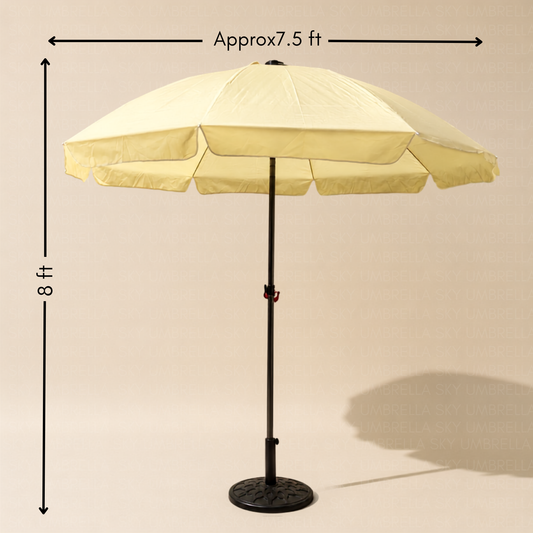
- Don't confuse umbrella weight with stand/base weight. If you're buying a garden or patio umbrella, the weight question that actually matters is the base's ballast weight for wind stability, which is a completely different calculation — covered in our Umbrella Stands & Bases buying guide.

Case Study: A Bulk Buyer's Freight-Weight Surprise
The following is an illustrative scenario built from a pattern commonly seen in corporate bulk-gifting orders — not a specific named client or a real Sky Umbrella transaction.
An HR team planning a 3,000-unit onboarding-kit gift for new hires across four city offices initially shortlisted a heavy-duty windproof umbrella purely because "windproof" sounded like the safer corporate choice. Midway through finalising the order, the team's logistics partner flagged that moving 3,000 units of a 16-rib, wooden-handle umbrella across four cities would add a meaningfully larger freight line than a lighter 3-fold model — a cost nobody had modelled at the shortlisting stage, because the RFP never asked about weight at all.
The team ultimately split the order: a lighter 3-fold model for the majority of general onboarding kits (where daily light-duty use was the real requirement), and a smaller batch of the heavier windproof model reserved specifically for the field-sales team members who actually needed it for outdoor client visits in heavier weather. The lesson that generalises: weight should be an explicit line in your RFP, not an afterthought discovered at the freight-quote stage.
Buying Guide: Choosing the Right Weight for Your Use Case
Daily commuters and students
Prioritise the lightest class that still has a reasonable rib count for your city's typical rain intensity. The 5 Fold Mini Pocket Umbrella (6 ribs, 5-fold) suits light-to-moderate rain and maximum portability; the Compact 3Fold Travel Umbrella, with its carabiner clip handle, is a good middle ground if you want it clipped to a backpack rather than buried inside it.
Everyday personal use (non-pocket priority)
The 3 Fold Ladies Umbrella or the Sky 3-Fold Automatic 10-Fiberglass-Rib Umbrella sit in the medium weight class — enough structure for genuine daily rain exposure without the heft of a full windproof build.


Corporate gifting and bulk promotional orders
The Promotional 2-Fold Umbrella is sized specifically for this use case (21–27 inch canopy options, made-to-order via quote), and its medium-bulk weight class is the right default for general-purpose branded giveaways where thousands of units will move through freight. See our Top 10 Industries Driving Bulk Umbrella Orders guide for sector-specific sourcing context, and our Minimum Order Quantities guide before finalising quantities.

Daily commute in heavy monsoon cities (Mumbai, coastal Maharashtra, Konkan)
This is where the extra weight of the Classic Premium Windproof Umbrella's 16-rib frame earns its keep. Don't downgrade to a lighter class purely to save on carry weight if your city's rain genuinely tests an umbrella's structure every single day.


Golf, events, and two-person coverage
The Double Layer Golf Umbrella is the heaviest class in this lineup by design — a 52-inch vented double canopy has to be substantial to do its job. Its own listing explicitly describes "ample protection for two people," which is only possible because of, not despite, its larger build.
Comparison Table: Sky Umbrella Models by Weight Class
| Model | Fold Type | Frame | Weight Class | Price (₹) | Best For |
|---|---|---|---|---|---|
| 5 Fold Mini Pocket Umbrella | 5-fold | 6 metal ribs | Ultra-light | 599 | Pocket/handbag carry |
| Compact 3Fold Travel Umbrella | 3-fold | Metal & fiber | Light | 599 | Backpack-clip travel |
| Sky 3-Fold Automatic (10 Fiberglass Ribs) | 3-fold | 10 fiberglass ribs | Light | 699 | Everyday auto-open use |
| 3 Fold Ladies Umbrella | 3-fold | Metal ribs | Medium | 550 | Daily personal use |
| Promotional 2-Fold Umbrella | 2-fold | Rust-resistant metal | Medium-bulk | 90–120* | Corporate bulk branding |
| Classic Premium Windproof Umbrella | Straight | 16 reinforced ribs | Heavy-duty | 1,599 | Heavy monsoon commuting |
| Double Layer Golf Umbrella | Straight | Fiberglass, vented double canopy | Heaviest | 350–450* | Golf, events, two-person cover |
*Bulk/quote-based pricing — contact Sky Umbrella for an order-quantity-specific quote; these are made-to-order items rather than instant-checkout stock.
Pros & Cons: Lightweight vs. Heavy-Duty Umbrellas
Lightweight umbrellas (ultra-light to light class)
Pros: genuinely pocket- or bag-portable, more likely to actually be carried every day, lower per-unit freight cost on bulk orders, lower cost per piece in most cases.
Cons: fewer ribs generally means less resistance to strong, sustained wind gusts; smaller canopies on the most compact models cover less of the body in sideways rain.
Heavy-duty umbrellas (heavy-duty to heaviest class)
Pros: higher rib counts and reinforced frames genuinely resist inversion better in strong wind; larger canopies give fuller coverage in sideways rain; double-canopy vented designs add wind-venting without sacrificing coverage.
Cons: meaningfully heavier to carry all day; higher freight cost per unit on bulk orders; typically a higher price point.
Industry Applications
Corporate gifting and HR onboarding kits: weight directly affects per-kit shipping cost when umbrellas are bundled with other onboarding materials and couriered to new hires or branch offices — a cost worth modelling before finalising vendor selection, not after.
Hospitality doorman and valet services: hotels generally prefer a heavier, straight-shaft umbrella like the Classic Premium Windproof Umbrella for guest-escort duty, where a sturdy feel and genuine wind resistance matter more than carry-weight, since the same staff member is not carrying it all day door-to-door the way a commuter would.
Delivery and gig workers: for riders who need an umbrella that survives being strapped to a two-wheeler and used for hours of continuous exposure, a mid-weight, higher-rib-count option is usually the better trade than the lightest possible pocket umbrella — a theme explored further in our Umbrellas for Delivery & Gig Workers guide.
Schools and colleges: for younger students, a lighter umbrella that a child can actually open, close, and carry unassisted usually matters more than maximum wind resistance — weight-appropriate sizing is part of what we cover in our Best Umbrella for Kids buying guide.
Pharma and BFSI field sales teams: field staff who carry an umbrella alongside sample kits or document cases for an entire working day tend to value a lighter, compact model over a heavier premium one, even when budget allows for the latter.
Bulk-Shipping Weight Math for Corporate Buyers
Freight for a bulk umbrella order is typically billed on volumetric or actual weight, whichever is higher — so per-unit weight becomes a real cost multiplier at scale, even if it looks trivial on a single piece. Here is a hypothetical, illustrative worked example only, using general industry weight-class assumptions, not a confirmed Sky Umbrella spec:
| Scenario (hypothetical) | Assumed class | Units | Illustrative total shipment weight |
|---|---|---|---|
| Light-class promotional order | Light/medium-bulk | 2,000 | Lower total weight tier |
| Heavy-duty windproof order | Heavy-duty | 2,000 | Noticeably higher total weight tier for the same unit count |
The table is deliberately qualitative rather than numeric, because turning an unconfirmed per-unit gram estimate into a fabricated total-shipment figure would be exactly the kind of invented specification this guide has repeatedly flagged against. The actionable takeaway is the same either way: before finalising a freight budget for any order above a few hundred units, request the exact packed weight per carton from Sky Umbrella's sales team. It is a two-line email that can meaningfully change a logistics line item, and it costs nothing to ask.
Frequently Asked Questions
How much does a standard umbrella weigh?
It depends heavily on fold type, rib count, and frame material — there is no single "standard" weight across the industry. A compact 5-fold pocket umbrella will always weigh meaningfully less than a 16-rib straight-shaft windproof umbrella, because they are structurally different products, not lighter and heavier versions of the same one.
Does a heavier umbrella always mean better quality?
No. Weight reflects rib count, frame material, and canopy size — not build quality on its own. A well-made lightweight umbrella built correctly for its intended light-duty use is not a lower-quality product than a heavier windproof one; they are engineered for different jobs.
Why doesn't Sky Umbrella list exact gram weights on every product?
Most Indian umbrella manufacturers, Sky Umbrella included, publish fold type, rib count, canopy size and frame material rather than a certified gram figure on the retail listing. If exact weight matters for your decision — particularly for a bulk freight calculation — request it directly from the sales team rather than estimating from the listing.
Is a lighter umbrella less windproof?
Generally, yes, in relative terms — windproof performance in this catalogue comes primarily from rib count and frame reinforcement (as in the Classic Premium Windproof Umbrella) or a vented double-canopy design (as in the Double Layer Golf Umbrella), both of which add weight. A lighter umbrella isn't "bad," it is simply not built for the same wind conditions.
What's the lightest umbrella Sky Umbrella sells?
Based on fold count and rib count, the 5 Fold Mini Pocket Umbrella (5-fold, 6 ribs) is the most compact and lightest-class option in the current catalogue for personal carry.
How does weight affect bulk corporate order freight costs?
Freight for large shipments is billed on actual or volumetric weight, whichever is higher, so a heavier per-unit weight class directly increases the shipping line item at scale — see the bulk-shipping section above for how to plan around this.
Conclusion
Umbrella weight is not a spec to obsess over in isolation — it is the physical signature of four real design decisions: fold count, rib count, frame material, and handle choice. Once you can read those decisions instead of just feeling a product in your hand, choosing the right umbrella for a daily commute, a corporate gifting program, or a two-person golf outing stops being a guess and becomes a straightforward match between your actual use case and the right weight class for it.
The honest gap we have flagged throughout this guide — that exact gram weights are rarely published across this industry, Sky Umbrella's own listings included — is also the simplest fix: ask before you order in bulk, and weigh a sample before you commit a freight budget to thousands of units.
Get the Right-Weight Umbrella for Your Need
Whether you need a pocket-light umbrella for daily commuting, a corporate-weight promotional model for a bulk gifting order, or a heavy-duty windproof umbrella for genuine monsoon conditions, Sky Umbrella's team can help you match the right weight class to your actual use case — and confirm exact packed weights for any freight-sensitive bulk order. Contact Sky Umbrella for a quote, browse the full Promotional Umbrella collection, or visit our Corporate Umbrella Manufacturer page to start a bulk order conversation. Learn more about who we are on our About Us page, or head back to the Sky Umbrella homepage to explore the full catalogue.