Umbrellas & Rain Gear for Construction Site Workers, Engineers & Supervisors in India (2026): The Complete Monsoon Safety Buying Guide
Spend a monsoon morning on any Indian construction site and you'll see the same scene repeat itself: a site engineer trying to hold blueprints, a phone, and an umbrella all at once while picking a path through ankle-deep mud; a mason laying blocks under a tarpaulin sheet rigged from bamboo poles because nobody issued him proper rain gear; a labour contractor's supervisor shouting over the rain to pause concrete pour because water is pooling in the shuttering. Construction is one of the very few Indian industries where "just buy an umbrella" genuinely isn't the right answer for most of the workforce — and where getting that distinction right has real safety and cost implications.
This guide breaks down exactly who on a construction site needs what kind of rain protection, why a handheld umbrella is often the wrong tool for the job, and which real, in-stock products from Sky Umbrella actually fit each role — from the site engineer doing rounds with a clipboard to the mason mixing concrete in the open to the labour contractor sourcing welfare-kit rain gear for 200 workers at once.

Table of Contents
- Why Construction Sites Are a Genuinely Different Buying Problem
- Four Roles, Four Budgets: Who Actually Needs What
- Site Engineers & Supervisors: The One Role Where a Handheld Umbrella Still Makes Sense
- Field Labour: Why a Rainsuit Usually Beats an Umbrella
- The Hard Hat Problem: Why Hands-Free Umbrellas Need a Fit Check First
- Fixed Shade for the Site Office, Muster Point & Material Yard
- Bulk Procurement: Labour Contractor Welfare Kits vs. Developer CAPEX
- Expert Safety Tips: Lightning, Rebar & Open-Site Hazards
- The Complete Buying Guide by Budget Tier
- Comparison Table: Umbrella vs. Rainsuit by Task
- Pros & Cons at a Glance
- Industry Applications: EPC, Real Estate, Infrastructure & Government Projects
- Case Study: A Mid-Sized Residential Tower Project
- Frequently Asked Questions
- Conclusion & Call to Action
Why Construction Sites Are a Genuinely Different Buying Problem
Every other workplace-rain-gear guide we've written — for mall security staff, housing society guards, gardeners, hospital staff — assumes a relatively fixed, relatively clean working surface: a lobby, a gate, a ward, a lawn. A construction site is none of these things. It's an open excavation one month and a half-finished structure the next, with loose earth, rebar, scaffolding, uneven flooring, and no permanent shelter until well into the project. That changes the entire buying calculus in three specific ways.
First, terrain and mobility work against a handheld umbrella for most roles. Anyone carrying material, operating tools, climbing scaffolding, or tying rebar simply cannot spare a hand to hold an umbrella — and trying to do so on wet, uneven ground is itself a slip-and-fall risk. Second, almost everyone on an active site is required to wear a hard hat, which immediately raises the question of whether a "hands-free" umbrella is even compatible with site PPE — a question most rain-gear buyers never have to think about, and one we address honestly later in this guide rather than overselling a product as something it isn't. Third, construction procurement is split across multiple budget owners in a way few other verticals are: the main developer or EPC contractor typically owns fixed-infrastructure spend (site office shelters, muster-point shade), while labour contractors — who supply and manage the actual workforce — usually own the recurring, per-head welfare-kit budget for rain gear. Getting a quote to the wrong budget owner is one of the most common reasons bulk rain-gear orders stall on construction projects.
Four Roles, Four Budgets: Who Actually Needs What
Rather than recommend a single "best umbrella for construction workers," it's more useful — and more honest — to split the site workforce into four groups, because each one has a genuinely different rain-gear need and a different person signing off on the purchase.
- Site engineers, supervisors & QA/QC staff — walk the site for inspections, carry drawings or a tablet, meet consultants and clients, but aren't doing continuous manual labour. A handheld umbrella works fine for this role.
- Field labour — masons, carpenters, bar-benders, helpers, machine operators — whose hands are occupied with tools and materials for most of the working day. A rainsuit, not an umbrella, is almost always the better call here.
- Labour contractors and HR/welfare teams — the people actually placing bulk orders for the workforce above, usually working to a per-worker welfare-kit budget that's separate from the main contract value.
- Site offices, muster points & material-checking counters — fixed locations that need standing shade rather than anything handheld, usually funded by the developer or EPC contractor as a one-time capital item.
The rest of this guide is organised around these four groups, with real, currently available Sky Umbrella products matched to each one.
Site Engineers & Supervisors: The One Role Where a Handheld Umbrella Still Makes Sense
Site engineers, project managers, safety officers doing rounds, and consultants visiting for inspection are the one group on a construction site whose work genuinely suits a traditional umbrella — they're walking, checking, writing notes, taking photos, occasionally shaking hands with a client, not continuously using both hands for manual tasks. For this role, the priority is wind resistance (open sites have far less wind-breaking cover than a city street) and a canopy wide enough to also shelter a drawing roll or tablet case tucked under the arm.
The Classic Premium Windproof Umbrella (₹1,599) is built around exactly this brief: a 27-inch canopy with 16 reinforced ribs — double the rib count of a standard umbrella — engineered to flex rather than invert under strong gusts, which matters on an open plot with no surrounding buildings to break the wind. It's available in navy, grey and black, colours that read as professional in a client walkthrough without looking out of place on a muddy site.
Field Labour: Why a Rainsuit Usually Beats an Umbrella
Expert tip: if someone on your site has to use both hands for their actual job — laying blocks, tying rebar, operating a vibrator for concrete, carrying cement bags — don't give them an umbrella and expect it to help. It will sit unused, get left behind, or get in the way at the exact moment it's needed most. A full rainsuit is almost always the right recommendation for continuous manual work in the rain, for the simple reason that it needs no hand to operate once it's on.
This is the same hands-occupied logic we found when researching gardening and landscaping crews, except construction labour spends a larger share of the day in sustained, heavier rain exposure, often at height or near electrical and machinery hazards where a loose umbrella canopy is also a genuine visibility and snag risk. Sky Umbrella's WeatherWise range covers this need across three practical tiers:

The WeatherWise Scorpio RainSuit (₹1,499) is explicitly built, per its own product description, to handle "aggressive" monsoon conditions with reinforced, wear-resistant fabric — a sensible default for workers who are outdoors through the heaviest part of the monsoon day. For a lighter entry tier covering shorter exposure or drier zones of the country, the WeatherWise Leo RainSuit (₹899) offers seam-sealed, water-resistant construction at a price that's realistic for large bulk orders. Both are full head-to-ankle coverage with sealed seams and pocket flaps to keep ID cards, phones or wage slips dry — something no umbrella can offer.

The Hard Hat Problem: Why Hands-Free Umbrellas Need a Fit Check First
A genuinely honest point worth making here, because it would be easy to oversell: Sky Umbrella's Rainbow Hand Free Cap Umbrella (₹250) is a real, popular hands-free product — a small canopy worn on an adjustable elastic headband, originally designed for gardening, fishing, beach days and festivals. On paper it looks like an obvious fit for any construction role where both hands need to be free. In practice, its own product listing describes it as an adjustable elastic headband design for sun and light-rain protection, with no claim about fitting over a hard hat, and its care instructions explicitly note it's "designed primarily for sun protection and light rain," not storm-grade wind.
Where most active construction sites require a hard hat at all times, that's a real compatibility question an HSE officer should check — ideally by ordering one or two sample units and trial-fitting them over the specific helmet model used on site — before placing a bulk order. It's a genuinely useful option for roles where a hard hat isn't continuously mandated (site office staff doing outdoor rounds, surveying crews working in already-cleared areas, material-checking staff at a covered yard gate) rather than something we'd recommend blind for active structural work zones.

For supervisory and junior staff who move between the site office and work areas carrying a bag, clipboard, or tool pouch, the Compact 3Fold Travel Umbrella (₹599) is a more dependable middle ground: its carabiner clip handle lets it attach directly to a backpack or tool bag, so it's genuinely hands-free in transit without claiming to double as PPE-compatible headwear.

Fixed Shade for the Site Office, Muster Point & Material Yard
Every active construction site has at least one spot where people gather and stand still long enough that fixed shade matters more than anything handheld: the site office entrance, the morning muster/attendance point, the material-checking or delivery-inward counter, the labour time-office. These are capital purchases, not per-worker welfare items, and they're usually signed off by the developer or main contractor rather than a labour sub-contractor.
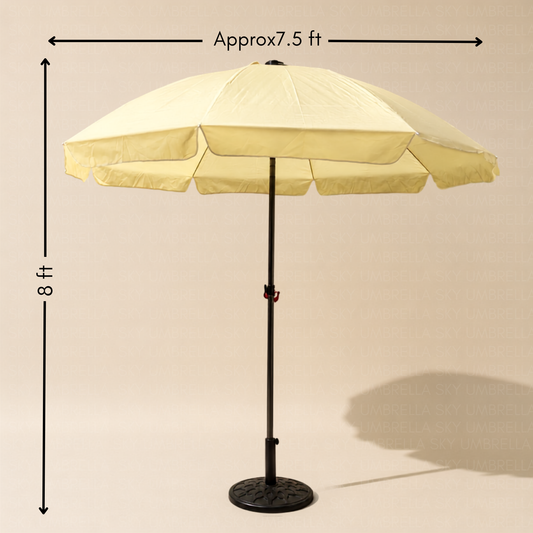
A Center Pole Garden Parasol Umbrella (₹3,499) with its 8-ft canopy and crank-open mechanism gives a muster point or material counter real standing cover, and pairs with a Heavy 8Kg Stand Base (₹1,200) since the umbrella itself ships without one — worth noting, as the Heavy 8Kg Stand Base currently has limited stock, so it's worth confirming availability before finalising a quantity for a multi-site order.

Bulk Procurement: Labour Contractor Welfare Kits vs. Developer CAPEX
On most Indian construction projects, two separate budgets exist for rain protection, and conflating them is one of the most common reasons a bulk rain-gear enquiry goes nowhere. The developer or main EPC contractor typically funds fixed-infrastructure items — the muster-point shade covered above — as a one-time capital line in the project budget. The labour contractor (or the main contractor's HR/welfare desk, on projects where labour is managed in-house) owns a separate, recurring per-worker welfare-kit budget that covers items like rain gear, usually renewed each monsoon season and sometimes tied into labour-welfare compliance expectations that EPC contractors and larger developers increasingly build into their own site HSE policies.
For this recurring welfare-kit line, Sky Umbrella's bulk promotional range offers two practical tiers. The Promotional 2-Fold Umbrella (₹90–120 per piece at bulk MOQ, quote-based) is the economy tier suited to large daily-wage or contract-labour headcounts across 21", 24" and 27" sizes. The 3 Fold Auto Open & Close Umbrella (₹250–350 per piece, quote-based) is a step up for supervisory staff or smaller, higher-retention crews, with a one-button auto open-and-close mechanism that's genuinely easier to use one-handed when the other hand is holding a tool bag.


Both are sold on a quote/MOQ basis rather than instant checkout — standard practice for bulk branded orders — and both can carry a contractor's or developer's logo for site-identification purposes as well as branding, which several of our other buyers (see our guides on custom umbrella printing methods and minimum order quantities) have used for exactly this purpose — a quick way for site security to visually confirm which contractor's crew someone belongs to.
Expert Safety Tips: Lightning, Rebar & Open-Site Hazards
- Treat lightning as a hard stop, not a rain-gear decision. Standard outdoor-safety guidance everywhere — not specific to any umbrella brand — is to stop work and move indoors or into a vehicle during lightning, rather than continuing to work in the open holding a metal-shafted object. This applies whether someone is holding an umbrella or standing near exposed rebar and scaffolding.
- Don't let a canopy become a snag or visibility hazard near machinery. A loose umbrella canopy near a moving crane, concrete mixer, or reversing vehicle is a genuine hazard in a way it isn't in a car park or garden — this is a strong part of the case for rainsuits over umbrellas for anyone working near active machinery.
- Brief new daily-wage labour on rain-gear issue as part of induction, not as an afterthought handed out once it starts raining — workforce turnover on construction sites is high, and a kit that sits in a store room doesn't protect anyone.
- Keep a small reserve stock of the economy-tier bulk umbrella or Leo RainSuit on site for workers who join mid-project or whose kit is damaged, rather than waiting for the next bulk reorder cycle.
The Complete Buying Guide by Budget Tier
| Budget Tier | Best For | Recommended Product | Indicative Price |
|---|---|---|---|
| Economy bulk (large daily-wage headcount) | Labour contractor welfare kits | Promotional 2-Fold Umbrella | ₹90–120/pc (MOQ, quote-based) |
| Entry rainsuit | Field labour, shorter/lighter exposure | WeatherWise Leo RainSuit | ₹899 |
| Heavy-duty rainsuit | Field labour, sustained heavy monsoon exposure | WeatherWise Scorpio RainSuit | ₹1,499 |
| Supervisory bulk | Site supervisors, smaller higher-retention crews | 3 Fold Auto Open & Close Umbrella | ₹250–350/pc (MOQ, quote-based) |
| Individual handheld | Site engineers, QA/QC, inspection walkthroughs | Classic Premium Windproof Umbrella | ₹1,599 |
| Clip-on companion | Staff moving between office and site carrying a bag | Compact 3Fold Travel Umbrella | ₹599 |
| Light-duty hands-free | Non-hard-hat-mandatory roles (verify fit first) | Rainbow Hand Free Cap Umbrella | ₹250 |
| Fixed site shade | Muster point, time office, material-checking counter | Center Pole Garden Parasol Umbrella + Heavy 8Kg Stand Base | ₹3,499 + ₹1,200 |
Comparison Table: Umbrella vs. Rainsuit by Task
| Task | Handheld Umbrella | Full Rainsuit |
|---|---|---|
| Site inspection walkthrough with drawings/tablet | Good fit | Unnecessary for short exposure |
| Masonry, carpentry, rebar tying | Impractical — hands occupied | Good fit |
| Working at height / near scaffolding | Not recommended — snag/visibility risk | Good fit |
| Operating machinery (mixer, vibrator, crane signalling) | Not recommended | Good fit |
| Moving between site office and work zones | Good fit (clip-on style) | Overkill for short transit |
| Standing at a muster point or checking counter | Fixed parasol, not handheld, is the right category | Not applicable |
Pros & Cons at a Glance
Handheld windproof umbrella — Pros: low cost, familiar, works well for walking/inspection roles, professional look for client-facing staff. Cons: unusable by anyone whose hands are occupied, becomes a hazard near machinery or at height, limited protection below the knee in heavy rain.
Full rainsuit — Pros: completely hands-free, full-body coverage including legs, pockets keep ID and documents dry, far safer near machinery and scaffolding. Cons: higher per-unit cost than a basic umbrella at the economy tier, less practical for brief indoor-outdoor transitions, needs proper drying/storage to last the season.
Fixed parasol + base — Pros: genuine standing shelter for a fixed point, no per-person distribution needed, one-time purchase. Cons: not portable, needs a weighted base sold separately, only solves the problem at one location.
Industry Applications: EPC, Real Estate, Infrastructure & Government Projects
This buying framework applies across the full range of Indian construction procurement: EPC contractors running industrial and infrastructure builds, real estate developers managing residential and commercial towers, metro rail and road-infrastructure projects with large transient workforces, and government public-works contracts where labour welfare compliance is often an explicit tender condition. Readers sourcing for a government tender specifically should also see our dedicated bulk umbrella procurement for government tenders guide, which covers tender-specific documentation and timelines not repeated here.
It's worth distinguishing this guide clearly from our separate Real Estate Site-Visit Umbrellas article: that piece is about branded hospitality umbrellas handed to prospective buyers visiting a sales gallery or site, not rain gear for the construction workforce itself — a genuinely different buyer and a genuinely different product tier.
Case Study: A Mid-Sized Residential Tower Project
The following is an illustrative scenario based on common patterns we see across construction-sector enquiries, not a specific named client.
A mid-sized residential tower project in a Tier-1 Indian city was running finishing-stage work through the monsoon, with roughly 150 contract labourers on site daily plus a dozen site engineers and supervisors. The labour contractor had been issuing basic umbrellas to the entire workforce each year, with most discarded within weeks because masons and bar-benders couldn't use them while working. Splitting the order — WeatherWise Leo RainSuits for the roughly 110 workers doing continuous manual tasks, Classic Premium Windproof Umbrellas for the 12-person engineering and supervisory team, and a Center Pole Garden Parasol with a weighted base installed at the labour muster point — brought the total rain-gear spend in line with the previous year's wasted umbrella reorders, while giving the manual workforce gear they could actually use without putting it down.
Frequently Asked Questions
Do construction workers in India need rain gear by law?
There's no single umbrella-specific national mandate, but worker welfare provisions under Indian labour regulations, combined with most large EPC contractors' and developers' own HSE policies, increasingly expect monsoon-season PPE and rain protection to be provided as part of standard site welfare measures. Confirm the specific requirement with your project's HSE or compliance team.
Is an umbrella or a rainsuit better for construction labour?
For anyone whose hands are occupied with tools or materials for most of the day, a rainsuit is the more practical and safer choice. Umbrellas suit roles that involve walking and inspecting rather than continuous manual work.
Can the Rainbow Hand Free Cap Umbrella be worn with a hard hat?
Its own product listing doesn't make that claim — it's an adjustable elastic headband design built for sun and light-rain protection. Trial-fit a sample over your site's specific hard hat model before placing a bulk order rather than assuming compatibility.
What's the minimum order quantity for bulk branded umbrellas for a labour contractor?
Both the Promotional 2-Fold Umbrella and the 3 Fold Auto Open & Close Umbrella are sold on a quote/MOQ basis — contact Sky Umbrella directly with your headcount for exact pricing and lead time. See our MOQ guide for general benchmarks.
Who should pay for rain gear — the developer or the labour contractor?
In most Indian project structures, the labour contractor (or the main contractor's HR/welfare desk) funds recurring per-worker rain gear, while the developer or EPC contractor funds fixed site-infrastructure shade like a muster-point parasol. Confirming this split early avoids a stalled procurement conversation.
Do these umbrellas offer UV protection for dry-season site work too?
Several of the products in this guide, including the Compact 3Fold Travel Umbrella, carry UV-protective canopies suited to year-round outdoor site work, not just monsoon use. See our UV protection ratings guide for what the UPF numbers actually mean.
Can rainsuits be branded with a contractor's logo for site identification?
Contact our team directly to discuss branding options on bulk rainsuit orders — our standard printing methods are documented for umbrellas in our custom printing guide, and the team can confirm what's achievable on rainsuit fabric for your order.
Conclusion & Call to Action
Construction sites don't need a single "best umbrella" — they need four different answers for four different roles, each tied to a different part of the project budget. Get the site engineers a windproof umbrella they can rely on during inspections, get the field workforce rainsuits they can actually work in, get the muster point proper fixed shade, and make sure the bulk order lands with the right budget owner the first time.
If you're sourcing rain gear for an upcoming project — whether it's 20 site engineers or 500 contract labourers — get in touch with the Sky Umbrella team for a bulk quote, or browse the full promotional umbrella and raincoat collections. Learn more about our bulk manufacturing capability on our corporate umbrella manufacturing page, or read about Sky Umbrella and our monsoon-gear track record across Indian industries. You can also explore our full range anytime from the Sky Umbrella homepage.