Custom Umbrella Printing Methods Explained: Screen, Digital, and Heat Transfer for Bulk Orders in India
Share
Every procurement manager who has ordered branded umbrellas has seen the same thing: a beautiful proof from the supplier, and then twelve months later, faded logos peeling at the edges on umbrellas still being carried around offices. The umbrella itself is fine. The printing is the problem. In nine out of ten cases, the wrong printing method was chosen for the order — usually because the buyer was never told there was a choice in the first place.
At Sky Umbrella, we manufacture custom umbrellas in Mumbai and ship pan-India for corporate gifting programs, hotel brands, real estate launches, pharma field forces, and bulk distributor orders. Across thousands of B2B briefs each year, the most common procurement gap we see is the printing decision. This guide walks through the three printing methods we use, where each one earns its money, and what your purchase team should specify before signing a PO.
The Three Printing Methods That Actually Matter
Vendors will list a dozen finishing options to sound thorough, but for branded umbrellas in India, three methods do nearly all the volume work: screen printing, digital printing, and heat transfer. Each has a sweet spot defined by quantity, color complexity, and how long the umbrella needs to look new.
1. Screen Printing — The Workhorse of Bulk Orders
Screen printing pushes thick, opaque ink through a mesh stencil onto each umbrella panel, one color at a time. It is the oldest method and still the most cost-effective for large orders with simple logos.
- Best for: 500+ piece orders with 1–4 spot colors (a logo, a tagline, a single graphic element).
- Durability: Excellent. The ink sits thick on the fabric and survives multiple monsoons without fading, provided the curing is done properly.
- Cost impact: Setup costs are higher because each color needs its own screen, but the per-piece print cost drops sharply as quantity rises. A two-fold umbrella with a single-color screen print typically lands in the Rs. 180–250 range at 1,000-piece volumes.
- Limitations: Not suitable for photographic images, fine gradients, or designs with more than 4–5 colors. The economics break down below 250 pieces.
If your brand identity is a clean logo with one or two solid colors — most banks, NBFCs, real estate developers, and FMCG brands fit this profile — screen printing is almost always the right answer.
2. Digital Printing — When the Artwork is Complex
Digital printing uses specialized inkjet technology to spray ink directly onto umbrella fabric, similar to how a high-resolution printer works on paper. It opened up creative options that screen printing simply cannot match.
- Best for: Designs with photographs, gradients, multiple colors, or complex artwork. Also useful for smaller runs of 100–500 pieces where screen setup costs would dominate.
- Durability: Good with proper inks and post-treatment. Slightly less long-lived than screen for harsh outdoor use, but acceptable for two to three monsoon seasons of regular handling.
- Cost impact: Higher per-piece cost than screen printing for simple logos, but no per-color setup charge. For a three-fold umbrella with full-color digital, expect Rs. 320–450 per piece at moderate volumes.
- Limitations: Colors can look slightly less saturated than screen on darker fabrics. Coverage on heavily textured fabrics like pongee can vary panel to panel.
Digital is the right call when a marketing team has invested in a rich visual identity that cannot be reduced to two flat colors — campaign-specific creative for product launches, hospitality brands with photographic motifs, or activation umbrellas tied to a TV campaign.
3. Heat Transfer — Precision for Small Detail and Small Runs
Heat transfer prints the design onto a special carrier film and then bonds it to the umbrella fabric using a heated press. It produces the cleanest edges of all three methods, especially for small text and fine lines.
- Best for: Detailed logos with fine type, small order quantities (as low as 50 pieces), and applications where edge sharpness is non-negotiable — luxury hotel umbrellas, premium gifting, or limited-edition runs.
- Durability: Reasonable. The transfer can show wear on heavily creased panels over time, so it is best paired with umbrellas that get less daily abuse — golf umbrellas, executive gifts, hotel patio brand markers.
- Cost impact: The most expensive per-piece option, but with the lowest setup overhead. Useful for short premium runs where a Rs. 600–1,500 golf umbrella needs a sharp logo and the order is only 100–300 pieces.
- Limitations: Large solid-color fills can show a slight sheen difference against the fabric. Not the right call for high-volume commodity branding.
The Procurement Decision Framework
Before you brief a supplier, run your order through three filters: quantity, color count, and end use. These three variables decide the method 90% of the time.
- Quantity above 500 + 1 to 3 colors: Screen print. Lowest unit cost, longest-lasting result.
- Any quantity + photographic or 5+ color artwork: Digital print. You cannot screen a gradient.
- Quantity below 300 + premium audience + fine detail: Heat transfer. Pay for the precision; it shows on the recipient's hand.
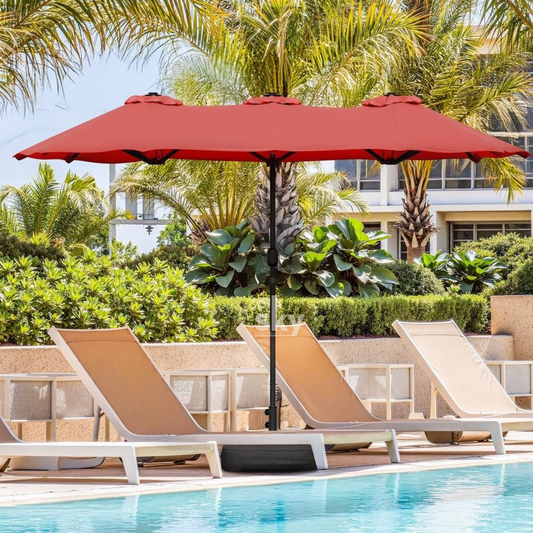
For garden and patio umbrellas in hotels and restaurants (typically Rs. 2,800–9,000 each), the calculus shifts slightly — these are read from a distance, so screen printing with bold logos almost always wins, even at lower quantities of 30–100 pieces, because durability against monsoon UV exposure matters more than fine detail.
What to Specify in Your RFQ
Most procurement disputes between buyers and umbrella suppliers come down to vague specifications. To get clean quotes that you can actually compare across vendors, your enquiry should state:
- Print method requested (or ask the supplier to recommend with reasoning).
- Number of print locations — single panel, two opposite panels, all panels.
- Number of colors per location.
- Pantone references for brand colors, not just "navy blue".
- Sample approval clause — always insist on a physical pre-production sample before bulk runs.
- Inspection criteria — alignment tolerance, ink coverage, and what counts as a rejectable defect.
A supplier that pushes back on these specifications, or quotes without a sample step, is one to avoid. Branded umbrellas are a one-shot impression on your customers and field staff; the printing decision deserves the same scrutiny as the umbrella itself.
How Sky Umbrella Handles the Print Brief
Our Mumbai factory runs all three methods in-house, which means we are not nudging buyers toward whichever process happens to be available. For every B2B enquiry, we review the artwork, the intended audience, the order quantity, and the budget, and then recommend the method that will actually look right when the umbrellas reach the recipient. We service corporate gifting orders for banks, hotels, pharma companies, real estate developers, and FMCG brands across India, with delivery from our Mumbai unit to all major metros and Tier-2 cities. You can see our wider range on the corporate umbrella manufacturer page, or browse the fancy and promotional umbrella collection to see printed samples.
Talk to Us About Your Custom Print Order
If you are planning a 2026 corporate gifting drive, a hotel patio refresh, or a campaign-specific giveaway, share your artwork and target quantity with us and we will come back with a method recommendation, sample timeline, and tier-priced quote.
Sky Umbrella — Mumbai-based manufacturing, pan-India delivery
Phone: +91 7021378548
Email: skyumbrellamumbai@gmail.com
Corporate enquiries: Contact our B2B team
Pre-monsoon offer: Use code MONSOON10 on bulk umbrella enquiries placed before the end of the season for a 10% indicative discount on qualifying orders.