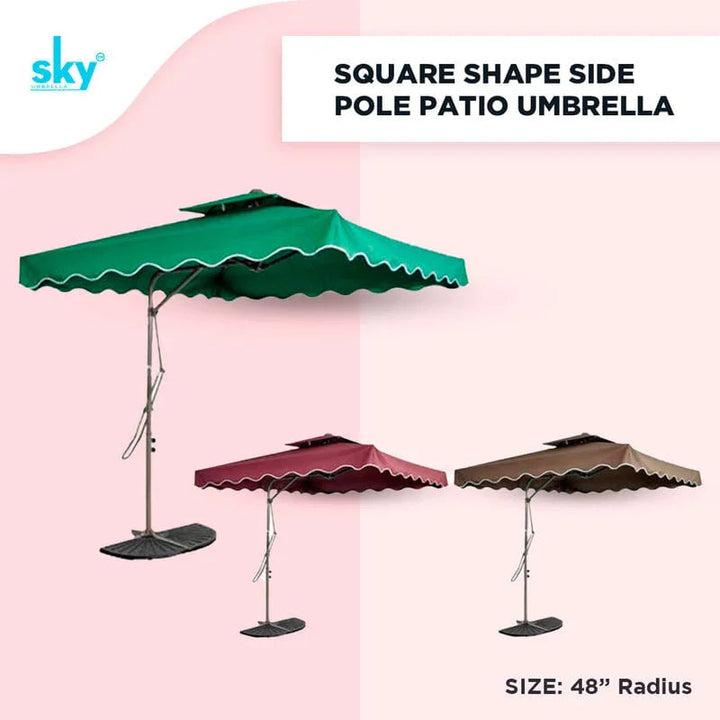
Transit Insurance for Bulk Umbrella Orders in India (2026): What Happens If Your Shipment Is Damaged or Lost

Two weeks before a 500-branch rollout, a logistics truck carrying 3,200 branded umbrellas skids off a wet highway outside Nashik. The umbrellas survive the accident. The leaking diesel tank and the fire that follows them do not. The buyer's procurement team — who had already signed off on artwork, paid the balance on dispatch, and blocked a launch date with their marketing agency — spends the next six weeks finding out that the transporter's legal liability for the load is a few hundred rupees per kilogram, not the ₹14 lakh the consignment was actually worth.
This is not an edge case. It is the single most common gap in Indian bulk-umbrella procurement once a buyer has already got the payment terms, the purchase order clauses, and the delivery-penalty structure right — none of those documents answer the one question that only comes up after something goes wrong in transit: who actually pays if the shipment is damaged, lost, or stolen before it reaches you?

This guide breaks down exactly what Indian transporters are legally required to pay you when goods are damaged in transit (it is less than most buyers assume), what a transit insurance policy actually covers, how to decide whether a given bulk umbrella order is worth insuring, and what to put in writing before the truck ever leaves the factory. It continues the procurement-paperwork series on this blog — if you haven't already locked down your purchase order clauses, your payment structure, or your freight terms, it's worth reading those first — this piece picks up exactly where freight terms leave off.
Table of Contents
- Why Transit Insurance Gets Skipped in Bulk Umbrella Orders
- The Legal Baseline: What a Transporter Actually Owes You Without Insurance
- The Types of Cover That Actually Apply to a Bulk Umbrella Shipment
- What a Transit Insurance Policy Covers — and What It Doesn't
- Who Should Actually Buy the Policy: Buyer, Vendor, or Transporter?
- How Premium Is Worked Out for an Umbrella Consignment
- A Practical Framework: Is This Order Worth Insuring?
- Comparison: Carrier Liability vs. Buyer-Arranged vs. Vendor-Arranged Cover
- What to Put in Writing: A Transit Insurance Clause for Your PO
- Step-by-Step: Filing a Transit Damage or Loss Claim
- Buying Guide: Matching Your Order Profile to an Insurance Decision
- Pros and Cons
- Industry Applications
- Expert Tips
- Case Study: A Multi-City Hotel Rollout, Illustrated
- Common Mistakes Buyers Make
- Frequently Asked Questions
- Conclusion
Why Transit Insurance Gets Skipped in Bulk Umbrella Orders
Umbrellas are an odd category for freight risk. Individually, most SKUs are cheap — a single branded umbrella rarely costs more than a few hundred rupees, which makes it easy to mentally file the whole category under "low risk." But a bulk order rarely ships as a few hundred rupees of goods. It ships as a pallet, or several pallets, of 1,000, 5,000, or 20,000 units travelling together in one consignment, on one truck, under one goods receipt note. The per-unit value is low; the per-truckload value is not. A 5,000-unit order of a ₹250 promotional umbrella is a ₹12.5 lakh consignment the moment it leaves the factory gate — before you add the branding cost, the missed launch date, and the reprint lead time if it has to be redone from scratch.
Buyers who have already read a freight-terms or delivery-penalty guide tend to assume the transporter is "responsible" for the goods once it signs the goods receipt note, and that this responsibility functions like insurance. It doesn't — it functions like a limited, capped liability, and the cap is set by the transporter's own terms and by statute, not by what your consignment is actually worth.
The Legal Baseline: What a Transporter Actually Owes You Without Insurance
Road transport of goods within India is governed primarily by the Carriage by Road Act, 2007 (which replaced the older Carriers Act, 1865, for registered common carriers). The Act holds a common carrier liable for loss, damage, or non-delivery of consignment — but two things matter in practice:
- Liability can be limited by the transporter's own declared terms and conditions — most transport companies in India publish, and courts generally recognise, a liability cap tied to the weight or declared value of the goods, not their actual replacement cost, unless a higher value was specifically declared and a corresponding freight surcharge paid.
- Proving fault and quantifying the claim is the buyer's or consignor's burden — the transporter is not obligated to proactively compensate you at full value; you generally have to establish the loss, document it, and in many cases pursue the claim through the Consumer Protection Act, civil court, or an arbitration clause in the transport contract, which can take months.
In practice, the "safety net" most buyers assume exists — "the transporter will pay for it if something happens" — covers a small fraction of what a bulk umbrella consignment is genuinely worth, and getting even that much paid out can take far longer than your event, launch, or gifting deadline allows. This is general information about the statutory framework, not legal advice for a specific dispute — if you are already in a live claim, a lawyer familiar with carriage and insurance law will read your transport contract and consignment note far more usefully than any guide can.
The Types of Cover That Actually Apply to a Bulk Umbrella Shipment
Inland (Marine) Transit Insurance
The policy that actually insures goods moving by road within India is still called "marine" or "inland transit" insurance by every major Indian general insurer — a naming quirk left over from when all cargo insurance grew out of maritime law, even though your umbrellas are travelling by road from a factory in Delhi NCR or Mumbai to a buyer's warehouse, not by sea. It is a distinct product from vehicle insurance (which covers the truck itself) and from standard fire/burglary policies (which typically only cover goods once they are inside a fixed premises).
Specific (Single-Transit) vs. Open (Annual) Policies
For a one-off bulk order — a single Diwali gifting consignment, a one-time branch rollout — a specific or "single transit" policy covering that one shipment is the normal approach. For a buyer who reorders through the year, especially one already locked into annual pricing with a vendor, an open or annual transit policy that automatically covers every declared consignment over the year is usually more cost-efficient than buying a fresh policy for each shipment, and removes the risk of someone simply forgetting to insure a given dispatch.
Who Actually Holds the Policy
This is a separate question from which type of cover exists, and it is the one most POs leave silent. A transit insurance policy can be taken out by the buyer, by the vendor (Sky Umbrella or any manufacturer), or occasionally by the transporter itself — but only the named policyholder (or a specifically named beneficiary under the policy) can file and collect on a claim. If your PO is silent on this, the default in most Ex-Factory arrangements is that insurance — if it exists at all — is the buyer's responsibility from the point of dispatch.
What a Transit Insurance Policy Covers — and What It Doesn't
A standard inland transit (marine) cargo policy in India is typically written on an "All Risks" or a more restricted "Basic/named-perils" basis. Broadly, buyers should expect the following coverage pattern, while always confirming the exact wording against the policy document itself rather than a general guide like this one:
| Typically Covered (All Risks policy) | Typically Excluded or Needs an Add-On |
|---|---|
| Fire, explosion, lightning during transit | Loss caused by inherent defect or poor packing ("inherent vice") |
| Accident to the carrying vehicle — overturning, collision, derailment | Delay-only losses (goods arrive intact but late, missing an event date) |
| Flood, cyclone, storm, and other weather-related damage en route | War, strikes, riots, and civil commotion (usually needs a separate SRCC add-on) |
| Total loss of the consignment (theft of the entire truck/load) | Partial pilferage with no police report or GRN discrepancy note filed |
| General average and salvage charges (for multimodal/part-sea legs) | Wear, tear, and ordinary leakage not caused by an insured peril |
Two practical notes follow directly from this table. First, "basic" or named-perils policies are cheaper but exclude theft and pilferage by default in many insurers' standard wordings — for a high-value or high-visibility consignment, confirm theft is explicitly included, not assumed. Second, packaging matters to your claim, not just to the goods themselves: if a loss adjuster can plausibly argue the damage happened because the umbrellas were packed carelessly rather than because of an insured peril, "inherent vice" is one of the most common grounds insurers use to reduce or deny a claim — which is exactly why our pre-shipment quality control checklist also covers carton integrity, not just product defects.
Who Should Actually Buy the Policy: Buyer, Vendor, or Transporter?
There is no universally "correct" answer here — it depends on who carries the commercial risk under your freight terms, which is exactly why this guide follows directly from our Ex-Factory vs. Door-Delivery guide. As a rule of thumb:
- Ex-Factory terms: risk typically passes to the buyer the moment goods leave the factory gate — so insuring the transit leg is the buyer's job, even though the vendor arranged the truck on the buyer's behalf.
- Door-Delivery terms: the vendor is contractually responsible for the goods until they reach the buyer's dock, so the vendor should be the one insuring the leg (or self-insuring it as a cost already built into the delivered price) — but a buyer should still confirm this in writing rather than assume it.
- Buyer's own transporter/pickup arrangement: if the buyer sends its own vehicle or appoints its own transporter to collect from the factory, responsibility for transit insurance sits squarely with the buyer from that pickup point onward, regardless of what the PO says about Ex-Factory or Door-Delivery.
How Premium Is Worked Out for an Umbrella Consignment
Marine/inland transit insurance premiums in India are typically quoted as a small percentage of the declared consignment value, with the exact rate varying by insurer, the type of cover (basic vs. all-risks), the mode and distance of transport, and the policyholder's claims history. We are deliberately not stating a specific percentage here — insurer pricing changes and we have not independently verified a current rate for this guide. Always get a live quote from your insurer or broker for your actual consignment value, route, and packaging before budgeting a figure into your landed cost.
What is worth internalising, qualitatively: the premium on even a sizeable umbrella consignment is a small line item next to the full replacement cost of a lost shipment. Reprint lead time, missed event dates, and re-running an entire branding and dispatch cycle rarely show up in the "value of goods" figure insurers price against, but they are very real costs to you.
A Practical Framework: Is This Order Worth Insuring?
Not every umbrella shipment needs a dedicated transit insurance conversation. A useful way to triage it is to weigh three factors together: per-unit and total consignment value, how replaceable the order is on short notice, and how fragile or damage-prone the specific product category is in transit.

| Order Profile | Example Sky Umbrella Product | Insure It? |
|---|---|---|
| High per-unit value, low stock, fragile/bulky construction, long remake lead time | Luxury Centre Pole Garden Umbrella (₹21,000, limited stock) or the 10 ft Thatch Side Pole Umbrella (₹30,000) | Yes, almost always — a single damaged unit is a meaningful loss, and the stock may not be quickly replaceable |
| Low per-unit value, large volume, tight event/launch deadline | 2 Fold Promotional Umbrella – 27" ordered in a 5,000+ unit run for a conference or Diwali gifting push | Yes — the per-truckload value is high even though the per-unit value is low, and a missed date cannot be bought back |
| Moderate value, high volume, flexible delivery window, in-house reorder stock available | WeatherWise Scorpio RainSuit ordered for routine year-round staff issue, not tied to a fixed date | Case-by-case — weigh the premium against how quickly a reorder could realistically be placed and delivered |
| Small pilot order, short distance, vendor's own local delivery vehicle | A sample batch of any SKU, under ~50 units, delivered within the same city | Often not worth a dedicated policy — but confirm this explicitly rather than assuming it, especially for high-value pilots |


Comparison: Carrier Liability vs. Buyer-Arranged vs. Vendor-Arranged Cover
| Relying on Carrier Liability Alone | Buyer-Arranged Transit Insurance | Vendor-Arranged Transit Insurance | |
|---|---|---|---|
| Who pays the premium | No premium — but no real cover either | Buyer, as a separate line item or via their existing corporate policy | Vendor, usually built into the delivered (Door-Delivery) price |
| Payout basis | Capped by the transporter's declared liability terms, often far below actual value | Declared consignment value, as agreed with the insurer | Declared consignment value, as agreed with the insurer |
| Who files the claim | Buyer, against the transporter — often disputed and slow | Buyer, directly with their own insurer | Vendor, with proceeds typically passed through or a replacement shipped |
| Best suited to | Very small, low-value, short-distance, non-critical orders only | Ex-Factory buyers, buyers with existing corporate insurance relationships, recurring annual-contract buyers | Door-Delivery buyers who prefer the vendor to carry transit risk end-to-end |
What to Put in Writing: A Transit Insurance Clause for Your PO
If you already have a purchase order template from our PO and supply contract guide, add a dedicated transit insurance clause rather than assuming it is implied by your freight terms. At minimum, the clause should state:
- Which party is responsible for arranging transit insurance for this specific shipment
- The declared value the policy will be written against (ideally the full invoice value including branding/print charges, not just the base product cost)
- Whether the cover is "All Risks" or a more limited named-perils basis, and whether theft/pilferage is explicitly included
- Who is named as the beneficiary entitled to file and receive a claim payout
- The documentation the vendor will provide to support a claim if needed — invoice, packing list, lorry receipt/consignment note, and photographs of packed goods before dispatch
Step-by-Step: Filing a Transit Damage or Loss Claim
- Do not accept the delivery without noting the damage. Record visible damage to packaging or goods on the transporter's delivery challan/proof-of-delivery document at the time of receipt — an unqualified signature can be used to argue the goods arrived in good condition.
- Photograph everything before you move or unpack further. Damaged cartons, the vehicle if accessible, and the goods themselves, with timestamps.
- Notify the insurer (or the party who holds the policy) immediately — most policies specify a short notification window, often within 24–48 hours of discovery, and delay can itself be grounds for a reduced payout.
- File a police report (FIR) for theft or pilferage claims — insurers will almost always require this before processing a theft-related claim, and it should be filed promptly, not after internal approvals are sorted out.
- Request a surveyor visit for any claim above a modest threshold — the insurer typically appoints an independent surveyor to assess and quantify the loss before approving payment.
- Submit the full documentation set — invoice, packing list, lorry receipt, delivery challan with damage noted, photographs, FIR (if applicable), and the surveyor's report.
- Track the claim through to settlement and keep a paper trail of every communication — claim timelines vary by insurer and complexity, and a documented history matters if a dispute arises later.
Buying Guide: Matching Your Order Profile to an Insurance Decision
Rather than treating transit insurance as a single yes/no decision for your whole relationship with a vendor, decide it order-by-order using the questions below:
| Question | If Yes | If No |
|---|---|---|
| Is the consignment value (goods + branding) above a threshold your finance team would call "material"? | Insure it | Lean toward skipping, unless other factors apply |
| Is this order tied to a fixed, non-movable date (an event, a launch, a festival window)? | Insure it — a reorder may not arrive in time even if the claim pays out quickly | Lower urgency, though value still matters |
| Does the product category include large, rigid, or fragile units (patio/garden/pagoda umbrellas, bases) rather than small folding umbrellas? | Insure it, and confirm packing standards with the vendor | Standard promotional umbrellas typically pack and travel more robustly |
| Is the stock for this SKU limited, meaning a lost shipment can't simply be replenished from existing inventory? | Insure it | Lower urgency if the vendor confirmed ready replacement stock |
Pros and Cons
| Approach | Pros | Cons |
|---|---|---|
| No dedicated insurance, rely on carrier liability | Zero added cost, simplest to administer | Capped, often minimal payout; slow and adversarial claims process; no real protection against total loss |
| Buyer-arranged specific transit policy | Full control over declared value and cover terms; buyer owns the claim relationship | Requires buyer-side insurance knowledge and a broker relationship; easy to forget for a one-off order |
| Buyer's annual/open transit policy | Every qualifying shipment automatically covered; no per-order admin | Only efficient if the buyer places frequent enough shipments to justify an annual policy |
| Vendor-arranged cover (Door-Delivery) | One less thing for the buyer to manage; cost is baked into a single delivered price | Buyer has less visibility into and control over the actual policy terms unless specifically requested |
Industry Applications
Hospitality chains and resort groups running multi-property rollouts (see our guide on branded umbrella programmes for facility-style operators for a related member-experience angle) often ship several high-value patio and garden umbrellas to different city locations in a single dispatch run — exactly the profile where a single transit accident can affect multiple properties' launch dates at once.
Banks and NBFCs rolling out branded umbrellas across dozens of branches simultaneously are moving a genuinely large aggregate consignment value even when each branch's allocation looks modest on paper.
Pharma companies timing umbrella gifting to conference and field-force cycles (see our guide on industries driving bulk umbrella orders) have a hard, non-movable conference date — a transit loss close to that date leaves no time for a reorder.
Real estate developers and event/wedding planners ordering decorative or large-format umbrellas for a single site launch or wedding date face the same hard-deadline problem, often with higher-value, lower-stock SKUs.
Expert Tips
- Always declare the full invoice value, including branding and printing charges, not just the base product cost — underdeclaring value to save a small premium amount proportionally reduces your payout if a claim arises.
- Ask your vendor for photographs of the packed consignment immediately before it leaves the factory — this becomes valuable evidence of the condition goods left in, useful for both insurance claims and ordinary delivery disputes.
- For recurring buyers, review your annual transit policy renewal alongside your annual rate-contract renewal with your vendor — it's an easy pairing to forget if the two are managed by different internal teams.
- Keep a standing checklist of documents to request immediately after any transit incident (see the step-by-step claims process above) rather than figuring it out for the first time under deadline pressure.
Case Study: A Multi-City Hotel Rollout, Illustrated
The following is an illustrative, composite scenario built from common patterns described across this automation's ongoing procurement series — it is not a named client or a specific real transaction.
A mid-sized hotel group ordering branded garden and patio umbrellas for a five-property rollout ahead of the wedding season split its shipment across two trucks for route efficiency. One truck, carrying roughly 40% of the order by value — including several higher-value centre-pole units destined for the group's flagship property — was involved in a highway accident. The umbrellas themselves were largely intact, but monsoon rain entering through a torn tarpaulin over several hours caused water damage to the canopies and packaging before the vehicle could be recovered.
Because the group's procurement team had declared full invoice value (including branding) under a buyer-arranged open transit policy, and had photographs of the consignment as packed at the factory, the claim moved through survey and settlement in time to place a replacement order and still meet the flagship property's launch date. The other four properties, whose allocations travelled on the undamaged truck, faced no disruption at all — a reminder that risk and value at stake can be very unevenly distributed across a single multi-location order.
Common Mistakes Buyers Make
- Assuming "the transporter is responsible" means the transporter will pay full value. It almost never does, for the reasons covered in the legal baseline section above.
- Leaving the insurance question to whichever freight term (Ex-Factory/Door-Delivery) is in the PO, without an explicit line confirming who actually arranges and pays for cover.
- Declaring a lower consignment value than the true invoice amount to save on premium, not realising this proportionally reduces any eventual payout.
- Signing the proof-of-delivery without noting visible damage, which can undermine an otherwise valid claim.
- Treating every order the same way instead of triaging by value, fragility, and deadline as shown in the decision framework above.
Frequently Asked Questions
Is transit insurance mandatory for bulk umbrella orders in India?
No. It is not a legal requirement for domestic road transport of general cargo like umbrellas. It is a commercial risk-management choice, and this guide is intended to help you make that choice deliberately rather than by default.
Does Sky Umbrella arrange transit insurance on bulk orders?
This varies by order size, delivery terms, and the specific agreement reached with the buyer — confirm directly with our team when placing your order so the responsibility is explicit in your PO rather than assumed.
What's the difference between transit insurance and the transporter's liability?
Transporter liability is a limited, statutory or contractually-capped obligation that applies automatically but rarely matches your goods' real value. Transit insurance is a separate policy you (or your vendor) choose to buy, written against a declared value you select, with its own claims process independent of any dispute with the transporter.
Can I insure just one high-value shipment without an annual policy?
Yes — a specific or single-transit policy covering one consignment is the standard approach for a one-off bulk order and does not require committing to an annual arrangement.
What happens if only part of my shipment is damaged, not all of it?
Partial damage claims are common and are assessed by a surveyor against the declared value and the documented extent of damage — this is exactly why photographing the consignment before dispatch and noting any damage at delivery both matter, as covered in the claims process above.
Should I insure a small sample or pilot order?
Often not worth a dedicated policy for a small, low-value, local sample — but if the pilot itself is high-value or tied to an important decision date, don't assume it's too small to matter; apply the same decision framework as a full order.
Conclusion
Transit insurance is the quiet gap at the end of an otherwise well-documented bulk umbrella procurement process. A buyer can get the RFP, vendor vetting, GST verification, purchase order, payment terms, artwork rights, and delivery-penalty clauses all exactly right — and still discover, only after a truck accident or a theft, that nobody arranged for the shipment itself to be covered. The fix isn't complicated: decide, order by order, whether the value and the deadline justify a policy; put it in writing as its own clause rather than assuming it's implied by your freight terms; and keep the basic claims-documentation habit — photographs before dispatch, noted damage at delivery, prompt notification — so that if something does go wrong, you're not building your case from scratch under deadline pressure.
If you're placing a bulk order and want help thinking through whether a given shipment profile is worth insuring, or want the freight and insurance responsibilities written clearly into your purchase order from the start, get in touch with our team. You can browse our full promotional umbrella range and garden and patio umbrella collection, learn more about us on our About Us page, or visit our corporate umbrella manufacturing page to start a bulk order conversation today.