Umbrella Purchase Orders & Supply Contracts in India (2026): What to Put in Writing Beyond the Spec Sheet
Most umbrella buyers in India get the technical spec sheet right. They write down rib count, canopy size, fabric, print panels and arrive at a per-piece price. Then they confirm the order over email or WhatsApp — "Confirmed, 500 units, 23-inch, 2 colour print, ₹180/pc" — and move on to chasing the vendor for delivery dates. What almost never makes it into writing is everything that happens when something goes wrong: who owns the artwork file after the order ships, what happens if the vendor is late, who pays if 40 units arrive with a smudged logo, and whether the vendor can reuse your design for someone else's order next month.
A spec sheet tells a vendor what to make. It says nothing about what happens if they don't. That gap is where most bulk umbrella disputes in India actually originate — not from bad products, but from commercial terms that were never written down in the first place. This guide walks through what a proper purchase order (PO) or supply agreement for a bulk umbrella order should contain beyond the spec sheet, with a line-item PO template, the clauses procurement teams most often skip, and a practical answer to the question we hear most from first-time corporate buyers: do I really need a lawyer for a ₹60,000 umbrella order?

Why a Purchase Order Matters More Than the Spec Sheet
A spec sheet is a description of a product. A purchase order is a commercial agreement. The two get treated as interchangeable in a lot of Indian bulk-buying conversations, especially when the order is being placed by a marketing, HR or admin team rather than a dedicated procurement function — which is common for corporate gifting orders of umbrellas, since they're often a once- or twice-a-year purchase rather than a core sourcing category.
The practical risk of skipping the PO is not that the vendor is dishonest. In our experience fulfilling bulk corporate orders, the overwhelming majority of disputes come from genuine misunderstandings that a one-page written order would have prevented: a price quoted "per piece ex-factory" being read as "delivered," a "sample approved" email being treated as approval for a colour variation nobody actually signed off on, or a delivery date mentioned once in a phone call that both sides remember differently three weeks later. A PO closes that gap by converting a conversation into a document both sides can point back to.
If you've already worked through our RFP and buying checklist and vetted your vendor against our vendor red-flags guide, this is the next document in the chain — the one that actually binds the quote you negotiated to what gets delivered.
Where This Fits in the Sourcing Journey
Over the past few weeks we've walked through the full lifecycle of a bulk umbrella order on this blog: writing the RFP and spec checklist, screening for vendor red flags, running the sample approval checklist, specifying pre-shipment quality control, reading the inspection report that comes out of it, and negotiating a resolution if that report flags a real defect. Every one of those steps assumes a document exists that both sides agreed to before production started. This article is that document — the purchase order or supply agreement that the spec sheet, the sample sign-off and every later negotiation ultimately refer back to.
Skip this step and every one of those later conversations gets harder, because there's no written anchor to negotiate from. Get it right once, and the rest of the process — including the uncomfortable conversations — becomes a matter of pointing to a clause rather than re-litigating what was "always understood."
Anatomy of a Proper Umbrella Purchase Order
At minimum, a bulk umbrella PO should read as a single page that a factory floor supervisor, an accounts team and a procurement manager could each independently use to check the order is being fulfilled correctly. That means specific line items, not a paragraph of prose. Here's the structure we recommend asking your vendor to confirm in writing, whether they draft it or you do:
| PO Field | What It Should Specify | Example |
|---|---|---|
| PO Number & Date | Unique reference both parties will cite in every future email | SU-PO-2026-1147, dated 30 Oct 2026 |
| Product & Size | Exact SKU/handle, size, fold type — not just "umbrella" | Promotional 3-Fold Umbrella, 23-inch |
| Quantity & Unit Price | Per-size quantity breakdown if sizes vary, locked price per unit | 800 units @ ₹190/pc |
| Print Spec | Panel count, colours, print method, Pantone/colour reference if critical | 2-panel logo, 1-colour screen print, Pantone 286C |
| Total Order Value & Taxes | Base value, GST rate and amount, final payable figure | ₹1,52,000 + 18% GST = ₹1,79,360 |
| Payment Schedule | Advance %, balance trigger, mode, bank/UPI details | 50% advance on PO, 50% before dispatch |
| Delivery Date & Address | Firm date (not "2–3 weeks"), exact delivery location(s) | By 20 Nov 2026, to Gurugram warehouse |
| Quality Standard | AQL level or inspection method both sides accept | AQL 2.5 (Major), per agreed inspection report |
| Packaging Spec | Individual sleeve/box, master carton count, labelling | Printed sleeve + 50 units/carton |
| Signatures & Date | Authorised signatory from both sides, with date | Procurement manager + vendor's authorised signatory |
Notice that none of these ten fields duplicate the spec sheet. A spec sheet already tells the vendor the umbrella should be 23 inches with a 2-panel logo. The PO adds the commercial layer on top: price, payment, delivery date, quality standard and signatures. Both documents should travel together, cross-referenced by PO number, and neither should be treated as a substitute for the other.
The Eight Clauses Most Umbrella POs Are Missing
Even procurement teams that do issue a formal PO often stop at the ten fields above. The clauses below are the ones that actually get tested when something doesn't go to plan — and they're the difference between a disagreement that resolves in one email and one that drags on for weeks.
Payment Terms & Price-Lock by Quantity
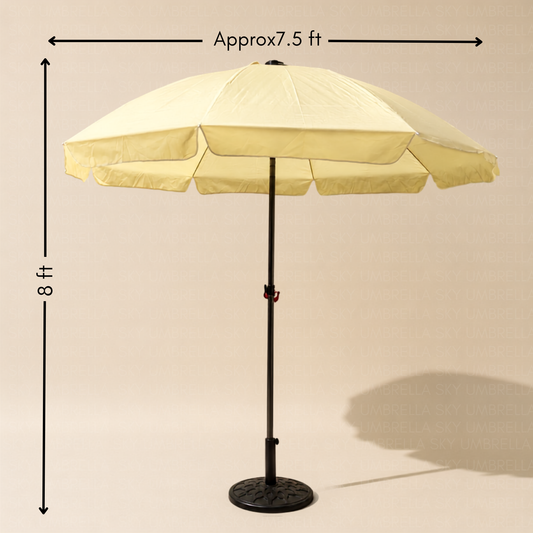
"50% advance, 50% before dispatch" is a start, but it's incomplete without three more details: what happens to the advance if the order is cancelled after production starts, whether the quoted price is locked regardless of raw material fluctuation during the production window, and whether the price changes if the final quantity differs from the PO quantity. Umbrella pricing is frequently quantity-tiered — our Promotional Garden Umbrella, for instance, is priced per size band rather than as a flat rate, and many vendors quote a lower per-unit price at 1,000 units than at 300. If your PO doesn't lock the price against the confirmed quantity, a shortfall in final order size can trigger a price renegotiation you didn't expect at invoicing stage.
Artwork Ownership & Reprint Rights
This is the clause we see skipped most often, and it matters more than most buyers assume. When you send a logo file for printing, does the vendor retain the right to reprint that exact design for a reorder without your sign-off? Can they use the artwork as a sample image in their own catalogue or on their website? Can a second buyer, unrelated to you, order an umbrella with your logo on it if they find the design file in the vendor's archive? A simple line — "artwork supplied remains the property of the buyer; vendor may not reuse, resell or display this artwork without written consent" — closes a gap that most POs leave entirely open. This matters more for banks, pharma companies and listed companies than almost any other clause in this list, given how closely regulated logo and brand-mark usage is in those sectors.

Quality Acceptance Criteria
Your PO should state, in writing, what standard the finished goods will be checked against before acceptance — ideally by referencing an AQL level the way we detailed in our inspection report guide. "Good quality" is not an acceptance criterion a court, an arbitrator or even a reasonable vendor can act on. "AQL 2.5 for Major defects, AQL 4.0 for Minor, zero tolerance for Critical defects" is. If your order is large enough to warrant a third-party pre-shipment inspection, name the inspection standard and who bears the cost of it in the PO itself, not as an afterthought once the goods are already in production.

Delivery SLA & Delay Penalty
"2–3 weeks" is not a delivery date — it's a range that becomes a dispute the moment week four arrives. A proper PO states a firm delivery date, and ideally a modest late-delivery penalty (a small percentage of order value per week of delay is standard across Indian bulk sourcing, and most reliable vendors will accept a reasonable one without objection). The penalty doesn't need to be punitive to be useful — its real value is that agreeing to one at all is a signal of how confident the vendor actually is in their own production timeline, which tells you something before you've paid a rupee.
Defect Resolution Path
If a pre-shipment inspection or an arrival check finds a real problem, what happens next shouldn't need to be negotiated from scratch — it should already be written down. State upfront which of the four standard paths (rework, replacement, discount or reprint) applies to which severity of defect, borrowing the framework from our rework-vs-replacement-vs-discount guide, and what happens if the shipment has already left the factory and the problem is only found on arrival, per our order-mismatch resolution guide. A PO that pre-agrees this path turns a stressful negotiation into a lookup.
Packaging & Branding Specification
Packaging is routinely treated as a detail to "sort out closer to dispatch," which is exactly how gifting orders end up with the wrong box, a missing note card, or a sleeve that doesn't match the branding brief. If your order includes individual gift packaging, note cards or QR-coded inserts — covered in more depth in our guides to gift packaging options and note cards and QR personalisation — the packaging spec and its cost per unit belong in the PO, not a separate verbal understanding with the dispatch team.
Confidentiality & Sample Retention
Two smaller clauses worth adding to any order above a few hundred units: a basic confidentiality line covering your pricing and order volumes (relevant if you're a brand that doesn't want competitors knowing your gifting budget), and a sample retention clause requiring the vendor to retain one approved physical sample, sealed and dated, for the duration of production. If a dispute arises over whether the bulk run matches what was approved, that retained sample — not memory, and not a photograph — is the reference point both sides check against.
Force Majeure & Dispute Resolution
A one-line force majeure clause (covering genuinely uncontrollable events — not routine production delays, which should be covered by the delivery SLA instead) and a dispute resolution line naming which city's courts or which arbitration mechanism applies are standard in any Indian commercial contract and cost nothing to include. Most bulk umbrella orders never need either clause invoked. The orders that do need it are exactly the ones where not having it in writing turns a solvable problem into a protracted one.
PO vs. Email Confirmation vs. Formal Supply Agreement
| Email/WhatsApp Confirmation | Single-Page PO | Formal Supply Agreement | |
|---|---|---|---|
| Typical order size | Under ₹50,000, one-off | ₹50,000 – ₹10 lakh | Above ₹10 lakh, or recurring annual contracts |
| Legal enforceability | Weak — relies on reconstructing intent from messages | Reasonable, if signed by both sides | Strong — drafted and reviewed as a contract |
| Covers artwork ownership | Rarely | If explicitly added | Yes, as standard |
| Covers delay penalties | Almost never | If explicitly added | Yes, as standard |
| Needs legal review | No | Not usually | Recommended |
| Best suited to | Small, trusted, repeat vendor relationships only | Most corporate gifting and one-time bulk orders | Multi-year framework deals, government tenders, listed-company vendor panels |
Buying Guide: When Is a Simple PO Enough?
Not every order needs a lawyer-drafted agreement, and treating a ₹40,000 Diwali gifting order the same way you'd treat a government tender wastes everyone's time. Use this as a rough decision guide:
- Under ₹1 lakh, one-time order, vendor you've used before: a single-page PO covering the ten fields in the table above is sufficient. Skip the formal agreement.
- ₹1–10 lakh, new vendor, or includes custom premium items: a single-page PO plus the eight clauses above, ideally reviewed by whoever handles your company's standard vendor contracts even if they're not a lawyer.
- Above ₹10 lakh, multi-location delivery, or a recurring annual order: a formal supply agreement with legal review. At this size, the cost of a half-day of legal review is trivial against the order value, and most vendors who handle institutional or government-adjacent business will already have a standard agreement template ready.
- Government tenders or listed-company procurement panels: follow your organisation's empanelment and procurement policy exactly — these typically mandate a formal agreement format regardless of order size.
Expert Tips From the Order Desk
Tip 1 — Put the PO number in every email subject line. It sounds minor, but it's the single easiest way to keep a multi-week order thread searchable and unambiguous when three different people are corresponding with the vendor.
Tip 2 — Never let "approved over call" replace a written sign-off. If a sample is approved verbally, send a one-line email confirming it the same day: "Confirming sample approved as discussed, [date], [PO number]." It takes thirty seconds and eliminates the single most common point of later disagreement.
Tip 3 — Ask for the PO to be countersigned, not just acknowledged. A vendor replying "noted" to your PO email is not the same as a signed document. For any order above a few lakh rupees, ask for a scanned signature or a digitally signed acceptance — most established vendors will do this without hesitation, and reluctance to sign is itself a useful signal.
Tip 4 — Keep the PO and the approved sample together, physically and digitally. A PO that references "as per approved sample" is only as good as your ability to produce that sample later. Photograph it from multiple angles and store the photos alongside the PO file, in addition to the physical sample retention clause above.
Case Study: The ₹4.2 Lakh Order With No Written Delivery Date
The scenario below is an illustrative composite built from patterns we see regularly in bulk umbrella procurement — it is not a specific named client or transaction.
A mid-sized real estate developer needed 2,000 branded umbrellas for a project launch event. The marketing team negotiated price, print spec and sample approval entirely over WhatsApp with a vendor they'd used once before, and the only written confirmation was a one-line message: "Confirmed, 2,000 units, ₹210/pc, event is mid-month." No PO was issued. Three weeks later, with the event date six days away, the vendor said the order would be ready "within the week" — technically consistent with what they believed "mid-month" had meant, since no exact date had ever been fixed in writing.
The resolution required an emergency part-shipment by air at the buyer's cost, a conversation that would have been unnecessary had the original confirmation included one line: "Delivery by [specific date], time-critical for an event on [event date], late delivery penalty of 2% of order value per day beyond that date." The vendor, when shown this framing after the fact, agreed it would have changed how they'd sequenced the production run. The product was never the problem — the absence of a firm, written delivery date was.
Industry Applications
| Industry | PO Clause That Matters Most | Why |
|---|---|---|
| Banks & NBFCs | Artwork ownership & confidentiality | Brand-mark usage is tightly governed internally; logo files should never circulate beyond the approved order |
| Pharmaceutical companies | Quality acceptance criteria, UCPMP-compliant documentation | Field-staff gifting orders need an auditable paper trail for compliance reviews |
| Hospitality & event planners | Delivery SLA & penalty | An event date doesn't move — the umbrella order has to arrive on time, every time |
| Real estate developers | Delivery SLA, packaging spec | Site-launch and project-event timelines are fixed and heavily promoted in advance |
| Advertising & event agencies | Artwork ownership, reprint rights | Agencies manage multiple client logos simultaneously and cannot risk cross-client artwork use |
| Government & PSU buyers | Formal agreement format, dispute resolution | Procurement policy typically mandates a specific contract structure regardless of order size |

Pros & Cons of Formalising a Small Order
| Pros of a Written PO (Even for Small Orders) | Cons / Trade-offs |
|---|---|
| Removes ambiguity on price, quantity and delivery date | Adds a day or two to the ordering process for a first-time vendor relationship |
| Gives you a document to point to if a dispute arises | Can feel disproportionate for genuinely small, low-risk repeat orders |
| Protects artwork and brand-mark usage | Some smaller vendors may be unfamiliar with formal POs and need guidance |
| Makes internal approvals and budget tracking easier | None of this replaces doing proper vendor vetting and sample approval first |

Frequently Asked Questions
Do I legally need a signed PO for a bulk umbrella order in India?
There's no law requiring a PO specifically for commercial goods orders of this kind, but without one, you're relying on email threads, WhatsApp messages and verbal understanding to establish what was agreed — which is considerably harder to act on if something goes wrong. For anything beyond a small, low-risk order with a vendor you trust, a written PO is standard commercial practice, not a legal mandate.
What's the minimum order value where I should bother with a formal PO?
As a working guideline, most procurement teams start issuing a formal PO somewhere between ₹25,000 and ₹50,000, though the right threshold depends more on whether the order includes custom branding and artwork than on value alone. A smaller order with sensitive logo usage can warrant more documentation than a larger order of a plain, unbranded product.
Can I use a standard company PO template for an umbrella order, or does it need to be umbrella-specific?
Your organisation's standard PO template is a fine starting point for the commercial fields — price, payment, delivery. Add the umbrella-specific technical fields (size, fold type, panel count, print method, AQL level) as an annexure or schedule referencing the agreed spec sheet, rather than trying to force them into a generic template.
Who should pay for a third-party pre-shipment inspection — buyer or vendor?
Either can, depending on what's negotiated, but it should be decided and written into the PO before production starts, not after a dispute arises. Many buyers split the cost or make it conditional on the outcome — vendor pays if the inspection fails, buyer pays if it passes.
What happens if the final delivered quantity is different from the PO quantity?
This should be addressed explicitly in the PO with a tolerance band — a common approach in bulk umbrella manufacturing is to allow a small percentage variance (commonly within 2-5%, though this varies by vendor and should be confirmed directly) above or below the ordered quantity, billed pro-rata, since production runs rarely land on an exact number. Without a stated tolerance, even a legitimate small shortfall can become a point of friction.
Does Sky Umbrella provide a standard PO or supply agreement template for corporate orders?
Our order desk works with corporate buyers to confirm every field covered in this guide — pricing, payment schedule, delivery date, quality standard and artwork terms — in writing before production begins; exact documentation format varies by order size and client requirement, so it's best confirmed directly with our team for your specific order.
Is a PO enough, or do I still need a separate NDA for my logo artwork?
For most corporate gifting orders, an artwork ownership clause within the PO itself is sufficient. A separate NDA is worth considering only for larger, multi-year vendor relationships, or where your organisation's internal policy requires a standalone confidentiality agreement regardless of order size.
This isn't legal advice, right?
Correct — this guide reflects common commercial practice in Indian bulk umbrella procurement, not legal advice specific to your situation. For a high-value order, a multi-year framework agreement, or any genuine contractual dispute, consult a qualified contracts professional who can review your specific terms.
Conclusion & Next Steps
A spec sheet and a purchase order answer two different questions. One describes the umbrella. The other describes what both sides are agreeing to if anything about that umbrella — its price, its timeline, its artwork, its quality — doesn't go exactly to plan. Most bulk umbrella orders in India go through without incident regardless of how much is written down. The ones that don't are where a one-page PO, built around the ten fields and eight clauses in this guide, is the difference between a quick email exchange and a drawn-out dispute.
If you're preparing a bulk order — whether it's 300 Promotional 3-Fold Umbrellas for a conference giveaway, a multi-size Promotional Garden Umbrella order for a hospitality rollout, or a premium Lion Handle gifting umbrella run for a leadership event — our team at Sky Umbrella will confirm every commercial term in this guide in writing before production starts. Browse the full Promotional Umbrella collection, read more on our Corporate Umbrella Manufacturing page, learn more about Sky Umbrella, visit our homepage to explore the full catalogue, or contact our order desk directly to get a proper PO drafted for your next bulk order — not just a quote.