5 Corporate Umbrella Gifting Mistakes Indian Businesses Keep Making (and How to Avoid Them)
Corporate umbrella gifting looks deceptively simple. You pick a color, add a logo, place an order, and move on to the next line item on your event checklist. In practice, we have watched enough gifting programs unfold from the manufacturing side to know that umbrellas are one of the easiest corporate gifts to get badly wrong, and one of the most visible when that happens. An umbrella is used outdoors, in public, often in bad weather, right when your brand needs to look its best. If it fails, everyone around your recipient sees it fail.
This article is written from the vantage point of a Mumbai-based manufacturer that has produced corporate and promotional umbrellas for a wide range of Indian businesses, from real estate developers doing mass launch giveaways to banks and consulting firms putting together premium client kits. Over that time, the same five mistakes keep showing up, across industries, budgets, and company sizes. None of them are exotic. All of them are avoidable if you know what to check before you sign a purchase order.
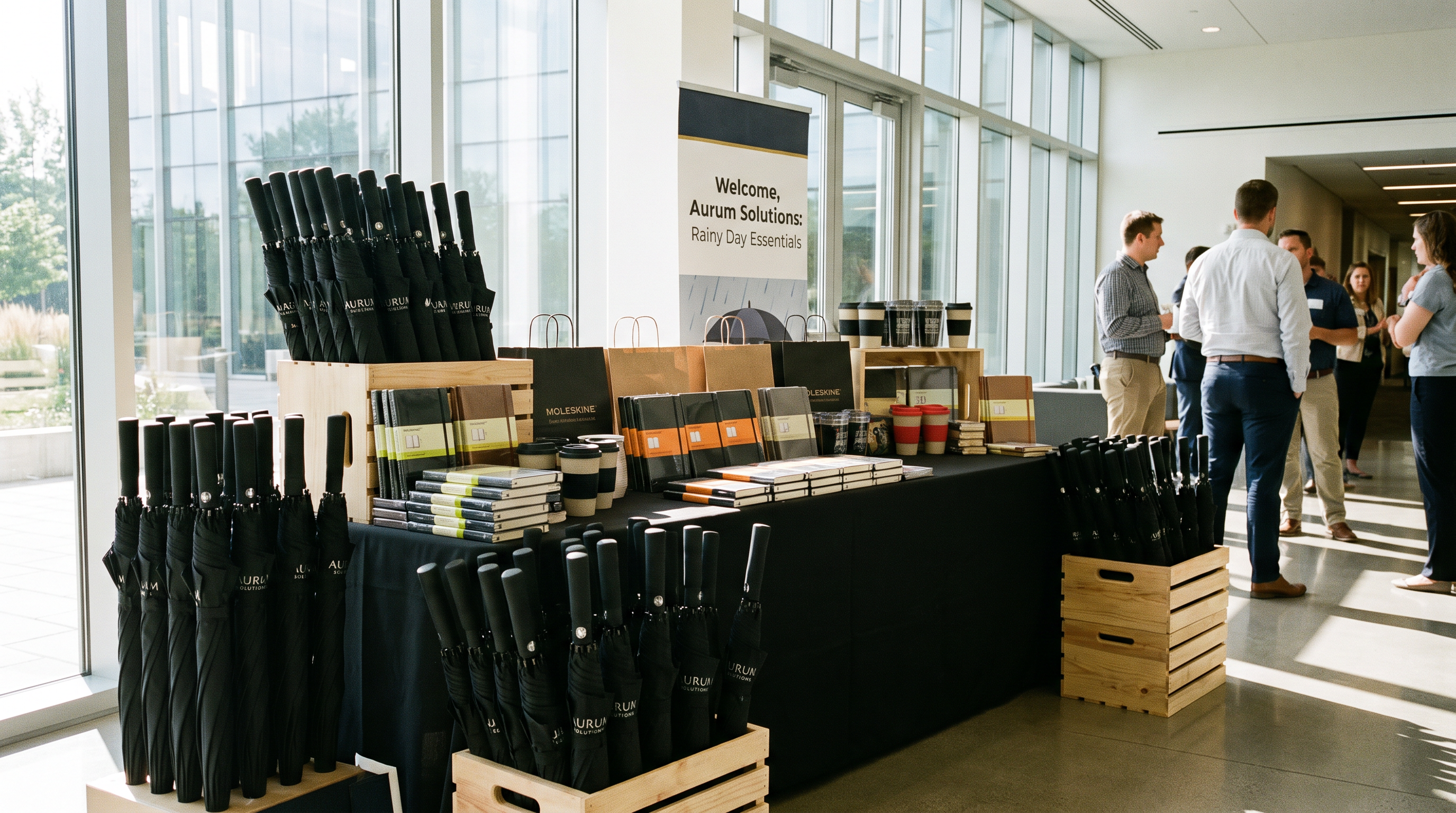
Table of Contents
- Mistake 1: Choosing the Cheapest Option Without Checking Frame or Fabric Quality
- Mistake 2: Getting the Print Area and Colors Wrong
- Mistake 3: Ignoring Lead Time Until It’s Too Late
- Mistake 4: Treating Every Recipient the Same
- Getting Gift-Tiering Right: 3 Fold Auto Open & Close Umbrella
- Mistake 5: Skipping the Sample or Proof Stage
- Mass Giveaway vs VIP/Executive Gifting: A Quick Comparison
- A Realistic Example
- Pre-Order Checklist
- FAQs
- Conclusion
Mistake 1: Choosing the Cheapest Option Without Checking Frame or Fabric Quality
This is the mistake we see most often, and it usually comes from a reasonable place. Procurement teams are handed a budget, they ask three or four suppliers for a quote, and they pick whichever number is lowest. On paper, an umbrella is an umbrella. In reality, the difference between a well-made corporate umbrella and a bargain-bin one comes down to a handful of things you cannot see in a quotation: the gauge and material of the ribs, the quality of the fabric coating, the stitching at the panel joints, and the shaft construction.
A frame built with thin, low-grade ribs will hold up fine in a showroom demo. It will not hold up when a gust of monsoon wind catches it on a Mumbai street, or when fifty of them are handed out at once and half get left open in a gusty parking lot. We have had clients come to us after a first bad experience with another supplier describing exactly this: umbrellas that inverted, ribs that snapped, canopies that tore away from the frame within the first real storm they were used in. The umbrella did not just fail, it failed in front of the customer or employee who was supposed to be impressed by the gift.
The fabric matters just as much as the frame. Cheaper pongee or polyester fabric without proper UV and water coating will often look identical to a properly coated fabric when it is dry and folded on a shelf. The difference shows up after a few weeks of actual sun and rain exposure, when the coating on the cheap version starts to flake, the color fades unevenly, or water starts seeping through the seams.
The uncomfortable truth is that a broken or leaking umbrella with your logo on it is worse than no gift at all. It associates your brand with something that failed, and it does so in a moment when the recipient is already mildly inconvenienced by bad weather. That is not the association any marketing team wants.
How to Avoid It
Ask your supplier directly what rib material and gauge they use, whether the shaft is fibre or a cheaper alternative, and what fabric GSM and coating they are working with. A manufacturer who has nothing to hide will answer these questions specifically rather than vaguely. It also helps to ask how long they have been supplying corporate clients and whether they manufacture in-house or route orders through a trading intermediary, since accountability tends to be clearer when you are dealing directly with the people making the product. Price comparisons only make sense once you are comparing the same underlying build quality, not just a rupee figure on a quote.
Mistake 2: Getting the Print Area and Colors Wrong
The second mistake sits at the opposite end of the spectrum from the first one, and it is almost always a cost problem hiding behind a design decision. Businesses either shrink the print area so far down that the logo becomes unreadable from more than a couple of feet away, or they insist on a multi-color, multi-panel print job that inflates the cost without meaningfully improving how visible or memorable the branding is.
An umbrella’s biggest asset as a promotional item is its canopy real estate. It is one of the largest branded surfaces a person will carry in public, and it is visible from a distance in exactly the kind of weather when people are paying attention to what is around them. Wasting that space on a tiny logo squeezed into one panel defeats the purpose of choosing an umbrella as the gifting medium in the first place. On the flip side, a five-color print with gradients and fine detail might look striking on a design mockup on someone’s laptop screen, but printing methods on fabric have real limitations, and every additional color or complex element adds to production cost and, often, to production time and defect rate.
We have seen marketing teams spend a surprising share of their umbrella budget on print complexity that recipients genuinely do not register as more premium. A clean, well-sized one or two-color logo, printed properly and positioned to be legible from a distance, communicates the brand better than a busy, colorful design that gets lost visually once the umbrella is actually open and in motion on the street.
How to Avoid It
Before finalizing artwork, ask your supplier what print size and placement they recommend for maximum visibility on the specific umbrella size you are ordering, and get a straightforward cost comparison between a simple one or two-color print and a more elaborate multi-color version. In most cases, simplifying the design saves money without costing you brand recall. If your logo already has multiple colors and simplifying it is not an option, at least confirm the print technique your supplier will use and ask for a physical or high-resolution digital mockup before committing to the full run, so you know exactly how it will look on fabric rather than on a screen.
Mistake 3: Ignoring Lead Time Until It’s Too Late
Every year, without fail, a wave of orders lands in the last two to three weeks before the monsoon starts or right before a major event date, with a request to somehow have thousands of finished, branded umbrellas ready almost immediately. Custom umbrella manufacturing involves multiple steps: fabric printing or dyeing, cutting, frame assembly, canopy stitching, quality checks, and packing. Skipping steps to hit an unrealistic date usually means one of two things happens: you pay a rush premium that inflates your per-piece cost, or quality control gets compressed and defects slip through.
There is a seasonal pattern to this that is very specific to India. Umbrella demand across the country spikes sharply as the monsoon approaches, which means raw material and production capacity across manufacturers gets tighter in that same window. Waiting until the first rains have already started in your city to place a bulk order is one of the most common and most avoidable planning mistakes we see. The same applies to events with fixed dates, product launches, conferences, or annual client gifting drives around Diwali. If the date is known months in advance, the order should be placed months in advance.
How to Avoid It
Work backward from your event or campaign date and build in a buffer, ideally placing bulk orders at least four to six weeks ahead, and earlier still if your order is large, your design is complex, or you are ordering right before the monsoon rush. Ask your supplier upfront what their current production lead time is, since it fluctuates seasonally, and get that commitment in writing as part of your order confirmation rather than a verbal estimate. If you already know you will need umbrellas every year around the same season, it is worth having that conversation with your supplier well before the season even starts.
Mistake 4: Treating Every Recipient the Same
This mistake is less about product defects and more about strategy, and it is arguably the most expensive one in terms of missed opportunity rather than wasted money. A lot of companies order one style of umbrella, in one quality tier, and hand it out to everyone, from a mass audience at a trade show booth to the CEO of a client company receiving a year-end appreciation gift. The logic seems efficient on the surface: one design, one supplier conversation, one production run. But it misses an important reality of corporate gifting, which is that different recipients warrant different levels of investment, and gifting the same item to everyone either overspends on the mass audience or underwhelms the VIP one.
A giveaway umbrella handed to hundreds of attendees at a trade show or distributed as a bulk promotional item does not need to be the most premium product in your range. Its job is visibility and reach at a reasonable cost per unit. A gift going to a key client’s leadership team, a top-performing employee, or a strategic partner is doing a different job entirely. It is meant to signal that the relationship matters enough to warrant something noticeably better, a heavier build, smoother mechanism, and a more refined look and feel. When companies use the exact same product for both purposes, the mass giveaway budget often gets stretched thin trying to make the “good enough for everyone” product look impressive, while the VIP recipients receive something that does not feel distinct from what a stranger got at a stall.
How to Avoid It
Segment your gifting list before you approach a supplier, not after. Decide roughly how many recipients fall into a mass or bulk tier and how many fall into a premium or VIP tier, and plan two different product specifications accordingly rather than one blanket order. It is also worth briefing your supplier on this distinction directly, since a manufacturer who regularly handles corporate gifting programs will usually be able to suggest an appropriate product for each tier rather than defaulting you to a single option across the board.
Getting Gift-Tiering Right: 3 Fold Auto Open & Close Umbrella

If you are building out a VIP or executive tier for a gifting program, this is exactly the kind of product that tier should be built around. The 3 Fold Auto Open & Close Umbrella is designed to feel like a deliberate upgrade rather than a slightly nicer version of the giveaway umbrella. It opens and closes fully automatically, one button to open, another to close and fold, with no manual effort required, which is a small detail that recipients notice immediately when they use it. The frame uses reinforced fibre ribs on a compact 3-fold shaft, the canopy is a waterproof polyester pongee fabric with UV coating available in a 21 or 23 inch size, and the handle is a premium ergonomic grip that can be branded as well.
This is not the umbrella we would recommend for a stadium giveaway or a mass conference handout, and that is precisely the point. Reserve it for the recipients where the gift is meant to represent the relationship, senior client contacts, board members, top-tier partners, or a leadership appreciation gift at year end. You can view the full specifications on the 3 Fold Auto Open & Close Umbrella product page.
Mistake 5: Skipping the Sample or Proof Stage
The final mistake is the one that causes the most stress, because it usually surfaces after the order has already been placed and paid for. A business finalizes a design over email, approves a digital mockup, places a bulk order for a few thousand units, and only sees the finished product when the full consignment arrives. If the color is slightly off from the brand’s Pantone reference, if the logo placement looks different on the actual canopy than it did on screen, or if the fabric feels thinner than expected, there is very little room left to fix it. Reprinting or remaking a large order at that stage is expensive and, depending on your event timeline, sometimes simply not possible.
Digital mockups are a useful starting point, but they cannot fully capture how a print will sit on curved, folded fabric, how a color will render once it is heat-transferred or screen-printed rather than displayed on a monitor, or how the finished piece feels in hand. This is exactly why asking for a physical sample or a pre-production proof before a large order is not an unnecessary extra step, it is basic risk management for anyone spending a meaningful budget on branded merchandise.
How to Avoid It
For any order beyond a small trial quantity, request a physical sample unit with your actual artwork before the bulk production run begins. Check the color match against your brand guidelines in daylight, not just under office lighting, check the print placement and finish, and physically test the opening and closing mechanism if you are ordering an automatic umbrella. If a sample genuinely is not feasible because of timeline, at minimum insist on a detailed pre-production proof with exact color codes and dimensions confirmed in writing before mass production starts.
Mass Giveaway vs VIP/Executive Gifting: A Quick Comparison
Here is a simple way to think about how the two tiers of a gifting program typically differ, based on what we see work well across client campaigns.
| Aspect | Mass Giveaway Tier | VIP / Executive Tier |
|---|---|---|
| Typical price range | Lower cost per piece, optimized for large volumes | Higher cost per piece, optimized for perceived quality |
| Use case | Trade shows, conferences, retail footfall, bulk employee kits | Key client gifts, leadership appreciation, strategic partner relations |
| Ideal product type | Straightforward manual-open umbrella with clean, simple branding | Premium mechanism umbrella such as an auto open and close model, with refined finish |
| Print approach | One or two colors, larger logo, fast turnaround | Careful color matching, premium handle branding, sample-approved before production |
| Ordering priority | Cost efficiency and reach | Impression and relationship signaling |
A Realistic Example
Picture a mid-sized real estate developer preparing for a residential project launch event, expecting a large turnout over a weekend during the early monsoon. To manage costs, the marketing team orders several thousand umbrellas from the lowest-quote supplier they could find, with a busy four-color logo design squeezed into a small section of the canopy, and the order is placed only about a week before the event because the final artwork approval kept getting delayed internally.
On the day of the event, it drizzles on and off, which is exactly the kind of weather where umbrellas should have been a highlight of the giveaway. Instead, several units invert in the wind within the first hour, a few ribs snap outright, and attendees who do get a functioning piece can barely make out the logo from a few feet away because the print is too small and too busy to read at a glance. Photos and casual mentions from the event end up associating the brand with a gift that felt cheap, which is the opposite of the impression a property launch is supposed to create.
This kind of outcome is avoidable at almost every stage described above: better frame and fabric quality, a simpler and larger print, ordering earlier to avoid the pre-monsoon rush and last-minute compromises, and a sample check before locking in a design that only looked fine on a laptop screen. This scenario is illustrative, not a specific past client, but it reflects a pattern we have seen play out in slightly different forms more than once.
Pre-Order Checklist
Before you finalize any bulk corporate umbrella order, it helps to run through a short checklist.
Confirm the frame material, rib gauge, and shaft type, not just the price per piece.
Confirm the fabric type, GSM, and whether it has UV and water-resistant coating.
Finalize a print design that is legible from a distance, and get a cost comparison between one, two, and multi-color options.
Place the order with enough lead time, ideally four to six weeks before your event or before monsoon season begins.
Decide whether you need one product tier or two, based on your recipient list, and brief your supplier accordingly.
Request a physical sample or a detailed pre-production proof and check color accuracy in natural daylight.
Get lead time, pricing, and quantity commitments confirmed in writing before production starts.
FAQs
How far in advance should we order branded umbrellas for a monsoon campaign?
As a general guideline, place bulk orders at least four to six weeks before you need delivery, and earlier if your quantity is large or your design involves multiple colors. Demand across the industry rises sharply as the monsoon approaches, so ordering early also protects you from rush charges and material shortages.
What is the minimum order quantity for custom logo umbrellas?
This varies by supplier and by product, since it depends on fabric availability, print method, and frame type. It is best to ask directly for the specific umbrella model you are interested in, since MOQs are usually set per product rather than as a blanket policy.
Can we order a small trial batch before committing to a large quantity?
Most manufacturers who work regularly with corporate clients can accommodate a smaller sample or trial batch, and we would strongly recommend doing this before any large order, particularly if this is your first order with a given supplier or a new design.
How do we decide how many colors to use in our logo print?
Start with your existing brand colors and ask your supplier how many of them can be printed cleanly and cost-effectively on the umbrella fabric and mechanism you have chosen. In most cases, one or two well-placed colors on a generously sized print area outperform a busy multi-color design in terms of actual visibility.
Should every recipient in our gifting program get the same umbrella?
Not necessarily. It is usually more effective to separate your list into a mass or bulk tier and a VIP or executive tier, and choose a product and finish appropriate to each, rather than applying one specification across every recipient.
What should we check when we receive a sample before approving a bulk order?
Check the color match against your brand guidelines in daylight, the placement and clarity of the print, the feel and weight of the fabric, and, if it is an automatic mechanism, that opening and closing works smoothly and consistently.
Conclusion
None of these five mistakes are complicated once you know to look for them. Cheap frames and fabric lead to umbrellas that fail exactly when your brand is on display. Overcomplicated print jobs cost more without improving visibility. Ignoring lead time turns a planned campaign into a rushed, compromised one. Treating every recipient identically wastes budget on one end and underwhelms on the other. And skipping the sample stage turns a bulk order into a gamble. Avoiding them is mostly a matter of asking the right questions before you place the order, not after.
If you are planning a corporate gifting program, whether it is a large mass giveaway, a tiered client gifting drive, or a first order you want to get right the first time, it is worth having a direct conversation with a manufacturer who can walk you through frame quality, print options, realistic lead times, and sample approval before you commit to a bulk quantity. You can explore Sky Umbrella’s range on our corporate umbrella manufacturer page or browse our promotional umbrella collection, and reach out for guidance before your next bulk order so you can avoid these five mistakes rather than learn them the hard way.