Monsoon-Ready Patio Umbrellas: What Indian Hospitality Buyers Should Specify Before Procurement
Share
The first heavy June downpour exposes every shortcut taken in last year's patio umbrella tender. Bent ribs, faded canopies, jammed pulleys, mildew streaks along the inside seams — most of it traces back to vague procurement specs rather than bad luck. For hotels, resorts, beach clubs, and F&B operators across India, the monsoon is not a freak event. It is a recurring four-month stress test that commercial umbrellas either pass or fail.
This is a buyer-side guide. If you are about to issue an RFQ, evaluate a sample order, or finalise specs with a vendor for the 2026 season, these are the lines to write into the brief before procurement closes. At Sky Umbrella, we manufacture patio and garden umbrellas for hospitality clients across India from our Mumbai facility, and the patterns below come straight from twenty-plus monsoon seasons of failure reports — ours and our buyers'.
Why generic "outdoor umbrella" specs fail in Indian monsoon
The default product sheet you'll see from most vendors is built for European or West Asian patios — moderate rain, low humidity, no salt spray. Drop that exact umbrella into a beach resort in Goa, a rooftop in Mumbai, or a poolside in Kerala, and you will replace it within eighteen months.
Coastal wind loads are not theoretical
Mumbai sees sustained 40–60 km/h gusts through July and August. Coastal Gujarat and Tamil Nadu regularly cross 70 km/h during monsoon depressions. A centre-pole umbrella with a six-rib frame and a thin steel pole is engineered for breeze, not wind. The first squall snaps the runner, and the canopy inverts.
Continuous wet-dry cycles attack the wrong materials
European specs assume the umbrella dries fully between rainfalls. Indian monsoon assumes nothing dries for four months. Mild steel rusts at the joint cups, polyester thread that isn't UV-stabilised disintegrates, and cheap pongee fabric delaminates from its waterproof coating after about thirty heavy soakings. Buyers who don't specify monsoon-rated materials end up paying twice.
Fabric and canopy: the four numbers your RFQ should name
Most procurement specs simply say "waterproof polyester canopy." That phrase commits the vendor to almost nothing. Write the actual numbers.
GSM and weave density
For commercial monsoon use, specify a minimum of 220 GSM for polyester or pongee canopies on garden umbrellas, and 240 GSM for side-pole or larger cantilever designs. Below 180 GSM, the fabric flutters loudly in wind and tears at the seam stress points by the second season.
Water column rating (hydrostatic head)
Ask the vendor to state the hydrostatic head figure. A rating of 1,500 mm or higher is the baseline for genuine waterproofing in heavy rain. Anything described only as "water-repellent" should be treated as a shower-grade product and rejected for monsoon procurement.
UV resistance (UPF)
For sun-side hours, UPF 50+ is the standard hospitality buyers should request. Beyond guest protection, UPF-rated fabric is also dyed and treated to resist the colour fade that turns a navy blue canopy into a washed-out grey by September.
Colour-fastness after wash cycles
Specify ISO 105-B02 grade 4 or better. Resort housekeeping teams will pressure-wash these umbrellas. The brand colour should still match the master swatch after twenty washes.
Frame engineering for monsoon survival
The frame is where price-cutting hurts most, and it's where buyers have the least visibility during sample evaluation. Push for these details in writing.
Pole material and gauge
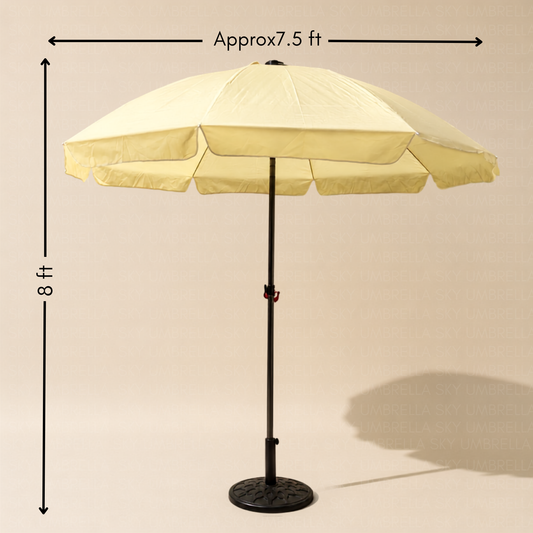
For commercial garden umbrellas, the choice is between powder-coated steel (heavier, cheaper, prone to coastal rusting if the coat chips) and aluminium (lighter, corrosion-resistant, ideal near pools and beaches). Specify a minimum wall thickness of 1.2 mm for steel and 1.5 mm for aluminium poles. Anything thinner flexes under wind load.
Rib count and rib material
Eight ribs is the minimum for a 2.5–3 metre garden umbrella; ten is better. Fibreglass ribs outperform steel in wind because they flex and recover rather than bending permanently. For coastal properties, fibreglass is the only practical option.
Hub and joint hardware
Brass or stainless-steel hardware at the runner, hub, and crank mechanism. Mild steel screws will seize within one monsoon. This is a small line item that decides whether maintenance can service the umbrella in season two or has to write it off.
Drainage, ventilation, and the parts that quietly fail
A vented canopy with a wind flap at the top reduces internal pressure during gusts. Without it, the canopy acts like a sail and either inverts or pulls the base off its anchor. Specify a double-tier ventilated canopy as standard for any umbrella placed in an open courtyard, rooftop, or poolside.
Drainage holes at the tip of each rib pocket sound trivial. They aren't — they prevent the pooling that rots stitching from the inside out. Ask the vendor to show you the drainage detail on the sample, not just on the spec sheet.
Procurement-side specs your RFQ should commit to writing
A clean monsoon-grade RFQ for hospitality patio umbrellas should bind the vendor to:
- Canopy: 220+ GSM polyester or pongee, 1,500+ mm hydrostatic head, UPF 50+, double-tier vented
- Frame: 8–10 fibreglass ribs, aluminium or 1.2 mm powder-coated steel pole, stainless or brass hardware
- Base/anchor: minimum 25 kg for free-standing 2.5 m units; in-ground sleeve for fixed installations
- Wind rating: tested to 50 km/h sustained gusts (request test certificate or video evidence)
- Warranty: at least 12 months on frame, 6 months on fabric, with clear monsoon-damage clauses
- Spare parts: canopy, runner, ribs available as separate SKUs for two seasons after purchase
If a vendor pushes back on the spare-parts clause, that is your single biggest red flag. Disposable umbrellas are a hidden capex problem disguised as a low unit price.
What this means for budget
Realistic price bands for hospitality patio orders in India
For monsoon-rated commercial units manufactured in India, expect the following bands in 50–100 piece orders:
- 2.5 m round garden umbrella, monsoon-spec, branded: Rs. 3,200–5,500 per piece
- 3 m square or octagonal patio umbrella: Rs. 4,800–7,500 per piece
- 3.5 m cantilever / side-pole umbrella with weighted base: Rs. 6,500–9,000 per piece
- Custom brand colour and printed valance: Rs. 250–450 surcharge per umbrella, depending on quantity
Anything quoted significantly below these bands almost always cuts on fabric GSM, rib material, or hardware grade. Run the sample through this checklist before approving the PO.
Sky Umbrella's monsoon-spec patio range
Sky Umbrella supplies hotels, resorts, restaurants, cafes, and clubs across India from a Mumbai manufacturing facility. The patio and garden range is built to the spec lines above as a baseline, with custom canopy colours, valance branding, and base options available against MOQ. Lead times for branded bulk orders are typically 18–25 working days, with pan-India delivery and on-site installation support in Mumbai and surrounding zones.
Browse the garden and patio umbrella collection for the current commercial range, or see the corporate manufacturing page for bulk customisation and procurement workflows.
Ready to spec your 2026 monsoon order?
Talk to our B2B team for a tailored quote, sample dispatch, and lead-time confirmation.
Phone: +91 7021378548
Email: skyumbrellamumbai@gmail.com
Enquiry form: Submit a B2B enquiry
Use code MONSOON10 on monsoon-season bulk orders confirmed before 30 September 2026.